Showing posts with label Imagi-nations. Show all posts

Monday, January 2, 2023

2022 painting round-up

Happy New Year, everyone!

Ever since I started tracking my painting a couple of years ago, I like to assemble it all at the end of the year for a review. For 2022, I painted 239 figures in total, down a bit from the last couple of years. The biggest contingents were two new DBA armies, who have previously been featured (Tlaxcalans, Undead), but my Proxian imagi-nations armies also saw considerable expansion (spurred on by several battles being fought over the course of the year.)


(There are a few absent from the picture - some chariot runners I painted for my dad as part of a rebasing scheme prior to a game at our local convention, a Leonardo tank painted for a club project, and a Scythian lancer borrowed to paint for a contest over at Benno's Forum.)

A few other highlights that I never got around to posting about on the blog:

Occiterran Red Hussars (from the Emhar Light Brigade set), painted up after the Occiterran defeat in April.

A proper Pharaoh for my Egyptians (from the Caesar set), painted up in time to lead the Egyptian army in my Battle of Djahy game at Barrage.

Camp followers for various DBA armies - Aztec and Tlaxcalan at left, Bronze Age at right.

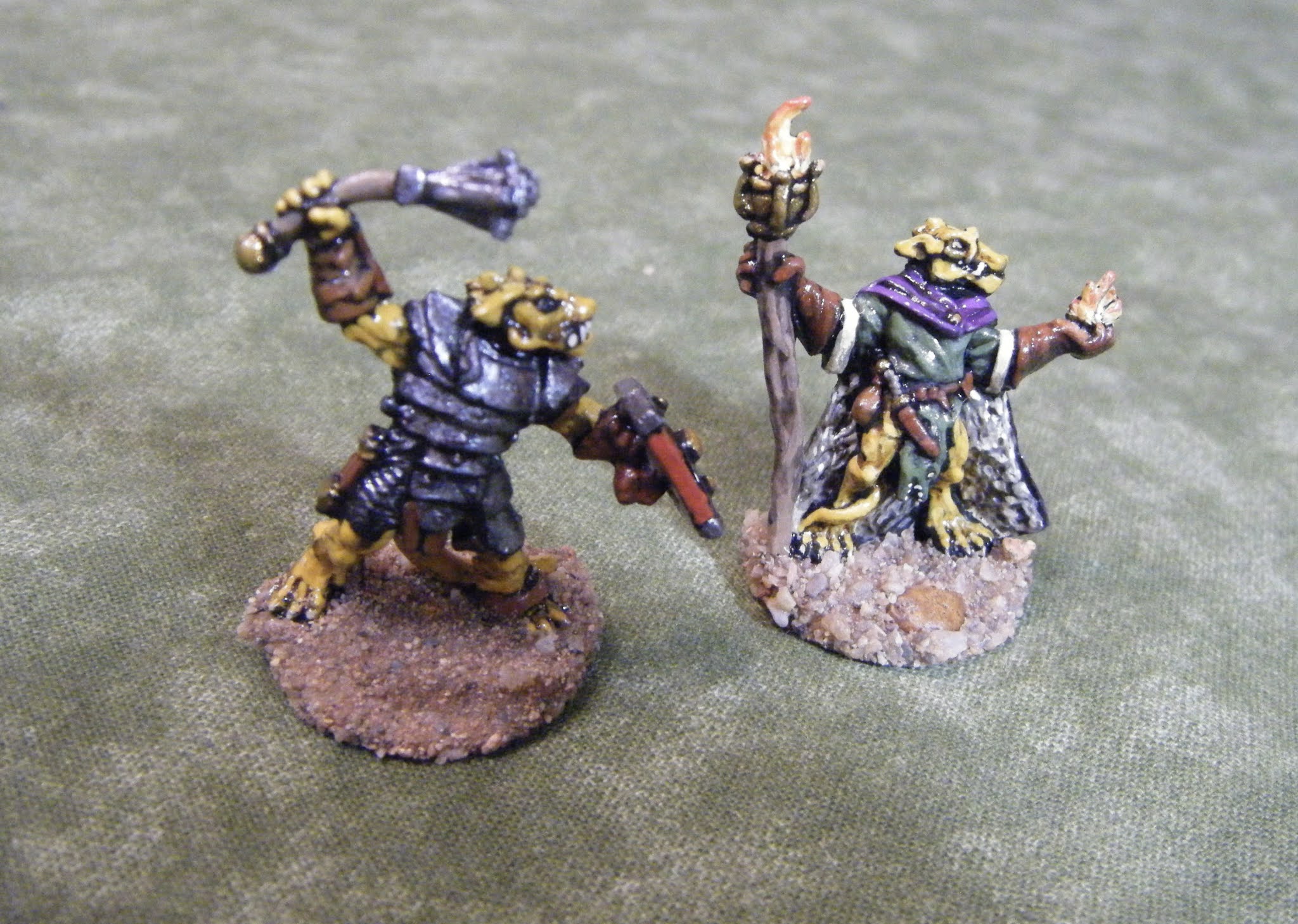
A selection of Reaper Bones adventurers.

As for 2023, no big plans yet - I'll just have to see what the year brings as far as painting and gaming! My brother stopped by yesterday for a couple of rounds and DBA and HotT, so we are off to a good start...


Wednesday, November 30, 2022

The Battle of Ollebetnom

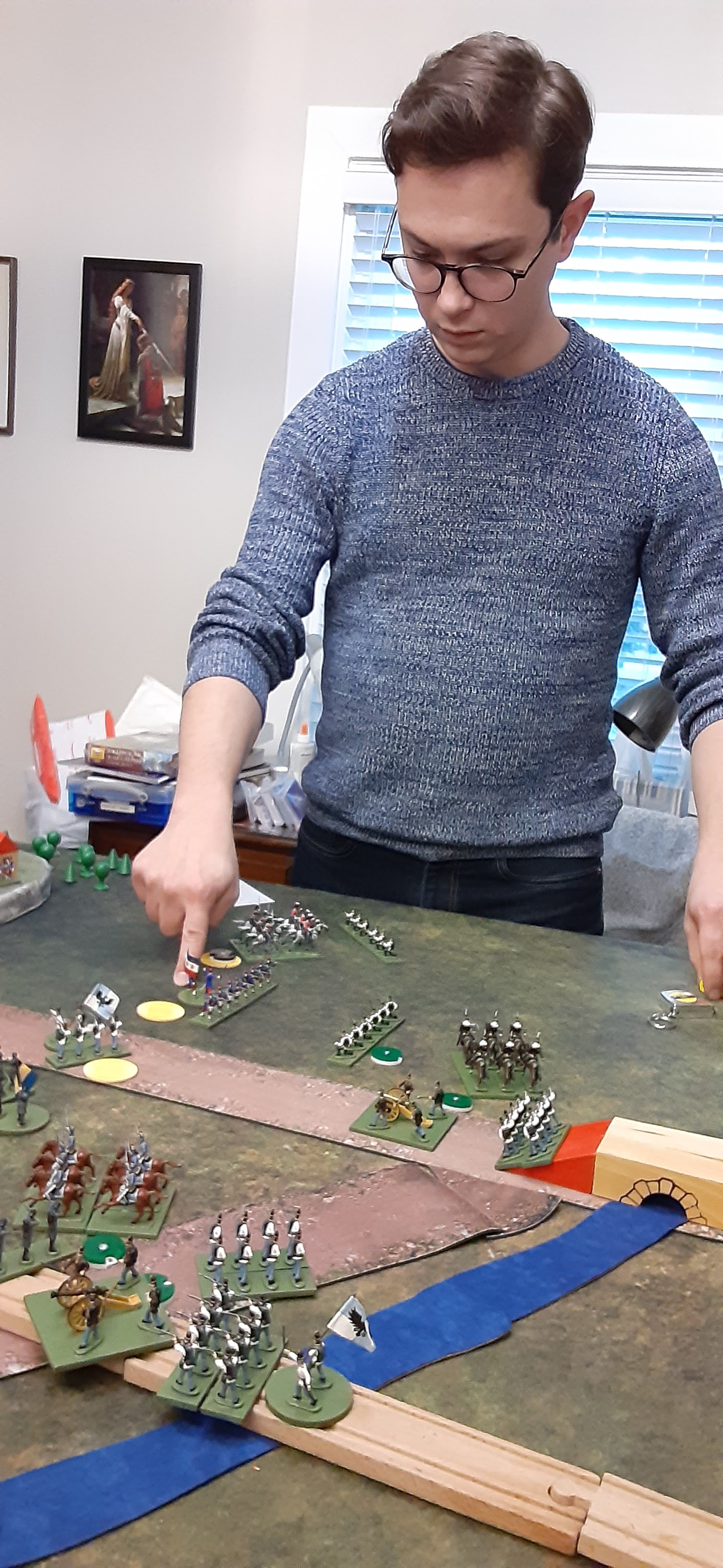
Since finishing his dissertation and escaping grad school this spring, my brother has moved back down to our part of the world and found a job here. Happily, this means we get to see him much more often, and there has been a certain amount of miniatures gaming going on as part of this! This past weekend, we were up at my dad's for Thanksgiving, and I brought along my Proxian armies for a game.

The scenario I decided upon was the Battle of Montebello from Neil Thomas's Wargaming 19th Century Europe book, which features a smaller French force attempting to cross a river and capture a town before larger and uncoordinated Austrian forces can muster a defense. The French also get to take advantage of a rail line that crosses the table to deploy some of their reinforcements. Because of the size and composition of the forces involved, I ended up reversing the scenario - my white-coated Elabrüners took the French role, while the Occiterrans in their blue jackets and red kepis took the historical Austrian role. (I also had to tweak some of the reinforcements a bit - so the Occiterrans had some cavalry that the Austrians did not have historically.) 

We had some fun setting up the table, digging into our childhood collection of Brio toys to find a suitable train and tracks that matched the classic toy soldier aesthetic. Unfortunately, I failed to notice until afterwards that the scenario was intended for a 3'x4' table rather than our 4'x6', which put Dad (attacking with the Elabrüners) at a distinct disadvantage. His foremost units were still one or two moves short of the town when time was called on turn 15. Still, my brother's stalwart defense with the Occiterrans definitely played a role as well, particularly in overcoming the command difficulties imposed by the scenario rules - only 1/3 of the Occiterran units could act at full effectiveness each turn. And most importantly, an enjoyable time was had by all!

Initial set up. The Occiterran commander grimly surveys the battlefield. The Elabrüner general seems dubious of this new-fangled "steam train."

Two regiments of Nordaleners arrive by rail in support of their Elabrüner allies.

Two regiments of Occiterran infantry attempt to delay the Elabrüner advance.

More reinforcements arrive for Elabrün, but in the background the Occiterrans have brought up fresh troops to occupy the town of Ollebetnom.

The Occiterrans are ordered to hold at all costs as the Elabrüners attempt to press down the road towards the town.

The Nordalener regiment has nearly reached the town, but without enough support to mount an assault.

The Occiterran Red Hussars, after futilely trying to chase down Elabrüner jagers, finally find a worthy foe in the Grey Uhlans.

Occiterran cuirassiers attempt to charge an Elabrüner cannon.


Tuesday, April 12, 2022

Action at Orángeville and Rougebourg

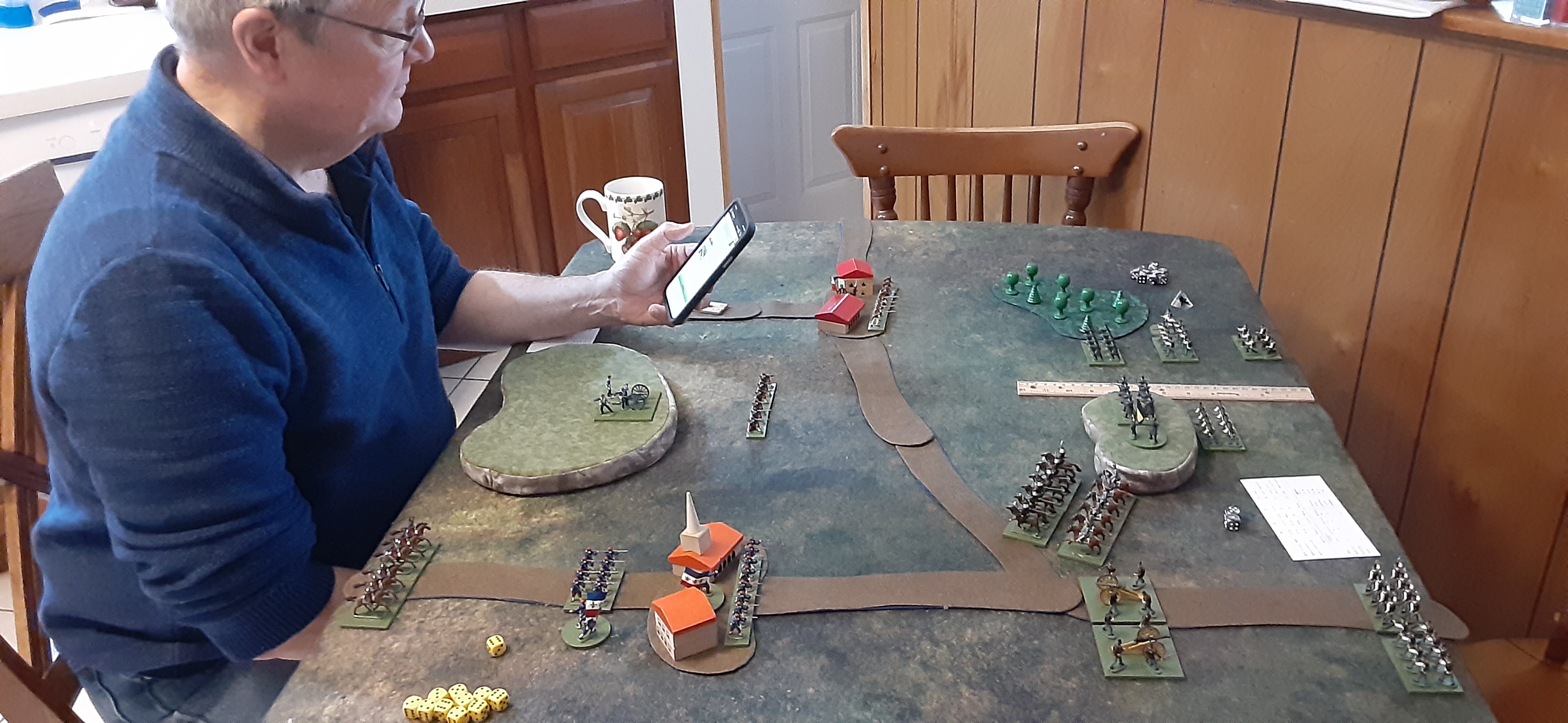
This past week my dad and I were both up in Michigan for my brother's thesis defense. (Congratulations again, William!) Figuring we would probably have some time on our hands, I brought along a few miniatures, including the Proxian armies I've been working on on-and-off for the last several years. With some terrain from my dad's travel kit, and a few pieces from a "Vacationland" playset hauled up from the basement, we set up a little game on my grandmother's kitchen table.

The last time I had out these figures (was it really almost five years ago?) we used Neil Thomas's One Hour Wargames. Those worked OK, but I thought they lacked a bit of period flavor, and so this time we tried his 19th-century rules instead. I liked these better overall, so we may give them another try the next time.

The scenario we came up with involved an Elabrüner attack on an Occiterran position - the Occiterrans set up in two small towns and a hill in-between, and the Elabrüners had to capture two of the three objectives within a time limit. Both sides had additional forces coming on over the first few turns. Dad decided he would prefer the role of defender, so I took the attacking force.

The situation a few turns in - most of the Elabrüner forces have arrived and started deploying.

As it turned out, my forces all arrived mostly on time and in a coherent manner - infantry behind the hill and woods opposite Rougebourg, and artillery and cavalry along the road to Orángeville. Dad's forces started off to relieve the more distant town, but I sent my cavalry out ahead to get in the way, which seemed to be well within their capabilities. One regiment managed to ride down some skirmishers before running headlong into canister fire; the other got involved in a melee with Dad's cavalry coming up from behind the town.

The Elabrüner guns have unlimbered and started to bombard the Occiterrans in Orángeville from beyond rifle range.

Most of the Elabrüner infantry has been committed to the attack on Rougebourg, while the cavalry attempts to delay Occiterran reinforcements.

A cavalry melee ensues as Elabrüner Blue Hussars clash with Occiterran cuirassiers. In the background, the last few of the Gray Uhlans throw themselves into the teeth of the Occiterran cannons.

Elabrüner and allied Nordalener infantry press on towards Rougeborg, stoutly defended by the Seridian Legion.

Since only infantry can assault towns, and they need a numerical advantage to be allowed to assault at all, I had to soften up the defenders before I could try to take either objective. Orángeville was conveniently in reach of my two artillery units, which gradually wore down the defenders, but with Rougebourg I had to push my troops forward quickly in column to cover the ground, then shake out into line to be able to shoot at the defenders, then re-form into column for the assault. This took a while, and I was fortunate that the Occiterran reinforcements had been delayed or distracted so that I had a significant numerical advantage.

With the defending Seridians driven off, Elabrüner troops occupy the town.

Artillery continues to fire on Orángeville as columns of Elabrüner infantry advance on the town. To the right, another Elabrüner unit arrives on the road from captured Rougebourg.

With one objective taken, I could now concentrate on the other, though we were about two-thirds of the way through our allotted time. Weakened by several turns of bombardment, the initial group of Occiterran defenders was wiped out by our assault, but we had taken enough casualties to be driven out in turn by an attack from fresh Occiterran troops. Fortunately I also still had one relatively fresh unit to throw into the fray, and with both towns in Elabrüner hands, the Occiterrans decided to cut their losses and pull back.

The Occiterran counterassault against Orángeville.

Final positions of the battle: with both towns occupied by Elabrün, the Occiterrans retreat back down the road.

All in all, it was a fun and satisfying little battle, and I hope to get these figures on the table again soon! 


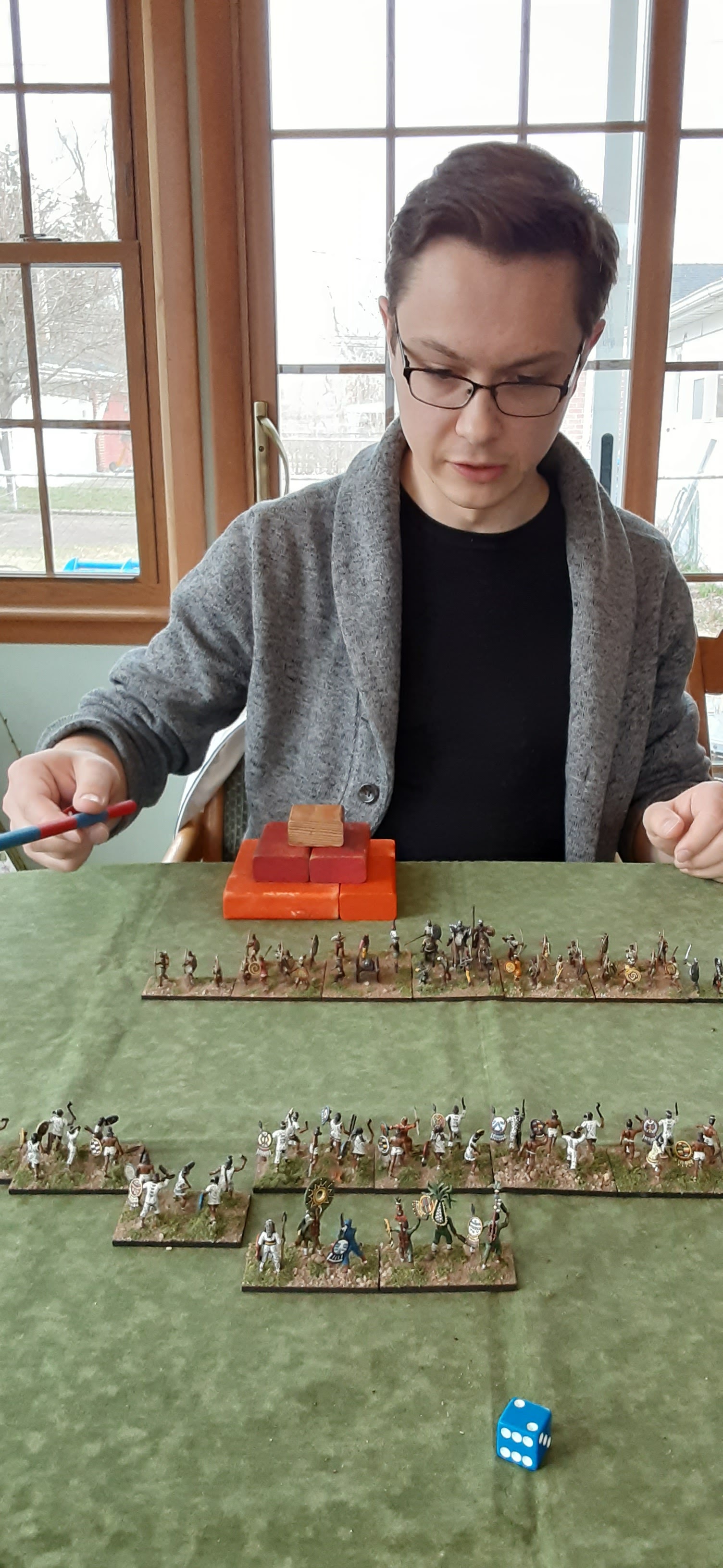
(We also slipped in a couple of games of DBA - the long-suffering Maya finally won a battle against the Tlaxcalans)

And Cortez didn't fare too well against the Aztecs either...

Friday, November 12, 2021

Nordalen and Seridia Join the Fray


This past month I've been working on a few different things in the miniatures vein, working off some pent-up energy after painting Mycenaeans for so long. One part of this was a return to Proxia, my 19th-century Imagi-nations setting, last seen about a year ago. Part of my plan from the beginning was to have two main combatants (Occiterre and Elabrün) and then two smaller contingents that could be allies to one or the other as needed (Nordalen and Seridia). I finally got around to painting up some troops and flags for the latter, so I thought I'd take this opportunity to introduce them. 


My concept for Seridia is that is broadly analogous to Italy, possibly with a bit of South American flair. (Some years back I was considering trying to model the War of the Triple Alliance; there's still a bit of that DNA in this Proxian project.) The Seridian flag is red, with a white canton containing a green star. Their troops may end up a little more irregular, and might feature in scenarios where I want to designate some troops of differing quality or temperament (militia, volunteers, revolutionaries, etc.) These particular figures are Italeri Confederate Infantry, though they may be supplemented by others at some point if I find ones I like the look of.


Nordalen, on the other hand, I'm imagining as a bit more like Switzerland or Scandinavia - rather mountainous and independent-minded. The Nordalener flag is a simple vertical tricolor of black, yellow, and blue. The figures I'm using for their infantry are Esci Crimean War Russians. Since I happen to have a rather plentiful supply of these, their role in scenarios may be to give provide one side a significant numerical advantage if needed.

I'm still considering what rules I would like to use for these - a few years back, my dad and I played a couple of games with them using Neil Thomas's One Hour Wargames, which worked well enough but I thought lacked a little flavor. I do plan on expanding this project a bit over the coming months, so if that goes as intended I may have more options available to me. I also had (what seems to me like) a fun idea for a series of games - a sort of "Famous Battle Charades" where I would set up various well-known battles using the various Proxian armies and see if the players could guess what they were re-fighting. We'll see if I get around to that at some point...

Friday, January 1, 2021

The little things that count - wrapping up 2020

Well, I don't know quite what I expected from 2020, but this wasn't it. I do feel quite fortunate to have come through the past year unscathed, and with my family and friends generally still in good health. And for all that this was a terrible year for other things, it was a great year for me getting painting done - at some point early in January I realized I had finished an average of one figure a day, and I decided to see how long I could keep up that pace. The answer turned out to be all year - I finished yesterday with 400 figures completed. This was the first year I have kept detailed logs, but I am sure this exceeds whatever my previous record was - and it may prove to be a high-water mark for some time to come! For the fun of it, I decided to lay out everything I painted this year, all at once:


The bulk of this is my six DBA armies, but there are a number of Reaper Bones figures and a few other odds and ends for other projects in there as well. A few of the miscellaneous miniatures that rounded out the year for me:


As mentioned at the end of my last post, these are old chariots I had painted some years ago, but rebased on 60x80mm bases for DBA, and with some new chariot runners added. The runners are a couple of spares left over from my Assyrians, and a couple of Robin Hood conversions. The bowmen are more Caesar Mitannian Mariyannu Chariot archers, dismounted to use as 4Bw in DBA. Between them, these will let my Syro-Canaanite army double as list I/19 Mitanni.


The other item mentioned as forthcoming in a previous post - a second piece of artillery for Elabrün. These are Waterloo 1815's Austrian Artillery set - and in this case, Elabrüner uniforms don't diverge too much from historical Austrians...


Moving to the Reaper Bones side - at some point back in August or so, I actually ran out of the 1-inch washers usually I use for basing 28mm figures, so I switched to working on ones which went on either larger or smaller bases. These ones are all on the small side: two kobolds, and two halflings. (Or possibly a gnome and a halfling.) Alas, the kobold's mace remains bent despite repeated attempts at straightening it in boiling water. 


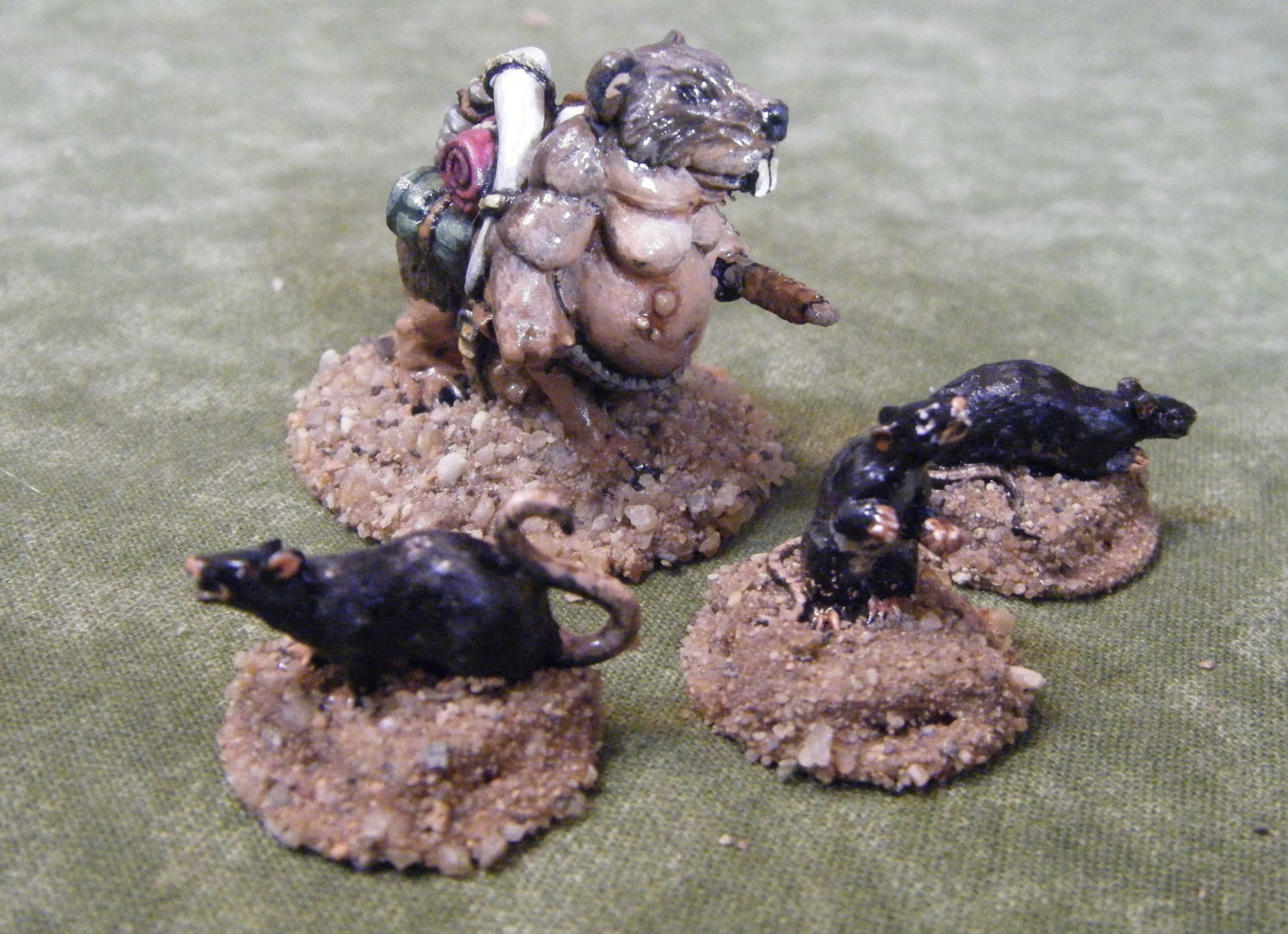
Some other assorted Reaper critters: the packrat had been sitting around primed but unpainted for at least a couple of years, but I finally got around to it this past month. The normal rats went much quicker. One of the things I enjoy painting most is animals (hence my delight at getting to paint some camelry earlier this year), so it was fun to paint up a couple of animal companions as a wolverine and a bald eagle. And as a Marylander, of course I had to paint the dire crab up as a blue crab!


This final one is a bit of an oddball - it's an old Mage Knight figure, carved off its original Clix base, repainted, and rebased onto one of the empty bases that had previously held a chariot. I still have several of these, so I will be on the lookout for more flying creatures or other ways I can put them to good use. And now with a giant eagle to hand, I find myself thinking about how to stage the Battle of the Five Armies, from the end of The Hobbit...

So that's it for 2020! Of course, one of the other silver linings of the past year has been the revival of this blog. Thank you to everyone who has stopped by, and especially those who have taken the time to leave comments. Hopefully this year's posts will include a few more games, but if not, I expect I will at least post pictures of whatever I decide to pain next! Happy New Year, and best wishes for 2021!


Sunday, December 13, 2020

A Dispatch from Proxia

One of the projects that has mostly lain dormant this year are my imaginary 19th-century countries, Occiterre and Elabrün. (For more information on them and their various neighbors, please consult this map, or reference the Encyclopedia of Proxia - now available in a new and updated edition!) However, a recent hitch in my supply chain caused me to dredge up a couple of units that had sat on my desk since the end of last year, and get them finished off:

The fellows on the left are more Occiterran infantry (from Emhar's French Infantry set), but the origins of the Elabrüner cavalry on the right are a little more complex. For my Elabrüner infantry, I've been using Waterloo 1815's Austrian Infantry, but for some reason that set is oversupplied with officers - each box comes with both four officers on foot and four mounted officers. I decided to press some of the latter into service as cavalry instead. Unfortunately, the horses they come with are in a dramatic rearing pose, and I didn't particularly want a whole unit of these, so I scrounged up some spares to remount them: 

Cavalry conversion in progress

Their uniforms are loosely based on this and similar images of Austrian hussars from the era (though I did not bother trying to add a pelisse):


Doing these up in a more "classic toy soldier" style made for a nice change from the Bronze Age figures I've been working on, but I do have one more army I'd like to complete for that project before the end of the year. After that, we'll see - I do owe Elabrün a second artillery piece at some point...

Monday, September 11, 2017

Commencement of Hostilities

From The Times of Mindon - March 4, 1854 AUT

WAR DECLARED
Occiterran troops force border crossing near Urell
Our correspondents in Lutens and Rugen have confirmed that a state of war now exists between Occiterre and Elabrun. This follows years of tensions between the continental powers over the North Seridian question, and Emperor Jules III's repeated statements of support for the rebels in Melaponte and Pollograta...

Reports from the frontier indicate that the Occiterran First Army have seized the crossing at Rougepont, but that the Elabruner Army des Westens under General Graf von Kettefurt has repelled a two-pronged attack on the town of Urell. If the Occiterrans can take the town, they may be able to capture the key passes of the North Canton that lie beyond, threatening to sweep into the disputed provinces along the Fredda River...

A response is expected shortly from the government of the Republic of Seridia, which has also supported the North Seridian rebels. Chief Minister Athelby and the House of Thanes have reaffirmed that Stratland will remain neutral...


This past weekend, the armies of my 19th century imagi-nations, Occiterre and Elabrün, finally got their first outing. Dad and I played three games using Neil Thomas's "One Hour Wargames" rules, using the some of the scenarios included in the book. I wanted something short and simple that would require only a limited number of units, and these certainly fit those requirements. The games were fast and entertaining enough, but maybe a little too simple - it seems like the side that is forced to move is at a distinct disadvantage, since units can't move and fore, and there are no distinctions for long vs. short range. On the other hand, the combinations of slightly randomized armies and classic scenarios offers a good amount of replayability that could be carried over to a different ruleset.


Occiterran infantry crosses a river with artillery support

The first game involved the Occiterrans crossing a river, with the Elabrüners attempting to gradually withdraw their forces while holding off the Occiterran advance. While the Elabrüner troops in the town did hold off the Occiterrans for a while, by the end of Turn 15, the Occiterrans had secured the bridge and proceeded to advance across the board.


Elabrüner infantry and jaegers defend a key hill

The second game involved a small Elabrüner force defending a hill against a larger Occiterran force while waiting for reinforcements. Elabrün was fortunate to have some light infantry available in this game, who stationed themselves in the small patch of woods at the base of the hill and proved a nuisance for the Occiterrans the entire game. The Occiterran assault petered out, and the Elabrüners were able to reinforce their position.


Occiterran forces press an unsuccessful attack on a town

The third game saw the Elabrüners once again taking a defensive position, this time in a town, which the Occiterrans were required to capture. Unfortunately for the Occiterrans, their forces this time included two units of cavalry, which by the rules were not allowed to enter the town, and their infantry was not able to carry the day alone.

So, overall score at the moment is Elabrün 2, Occiterre 1. So far Elabrün seems to be holding out pretty well against the invasion; maybe a counterattack will come next, or maybe Occiterre will bring more forces to bear...

Saturday, September 9, 2017

The Encyclopedia of Proxia

A bit of background on some of the countries from this map, the setting for my 19th-century Imaginations wargaming project:

DOBRIA

Dobria first appears in the annals of history as a vassal of the Maxenian Empire during the early Chivalric Age, founded by a tribe of nomads from the Procalan Steppe. Dobria’s fortunes waxed and waned alongside the Maxenian Empire - when the Maxenians were strong, Dobria became a province, ruled by a Maxenian governor. When the Maxenians were weakened by wars in the Procalan provinces, the Dobrians broke free and built a substantial kingdom in Eastern Proxia. As the Maxenians regained their strength, the Dobrian kingdom was reduced to vassalage once more, and when Maxenopolis fell at last, Dobria took on a similar relationship to the Koraman conquerors. In the last century, as the Koraman Empire in turn has weakened, the Dobrian princes have regained independence once again, this time with covert aid from the Elabruners and Gospodinians.


ELABRUN

The Emperor of Elabrun rules a vast large and diverse realm, from the plains of the east to the mountains in the west, and his subjects speak a dozen languages or more. This Empire has been slowly patched together since the Chivalric Age by the Falkenburg family, who started as Dukes of a small Nordoric state in the Nivean Mountains. Through advantageous marriages and shrewd alliances, they expanded their realm, and by the end of the Chivalric Age, the Falkenburgs ruled the sizable Duchy of Rugen and had holdings as far away as northern Seridia.


With the fall of the Maxenian Empire, the Falkenburgs found themselves in the path of the Koraman advance, as the victorious nomads swept through Stecjia and conquered the city-states along the Muriatic Sea. However, the Falkenburgs were able to raise an army of their own from among their vassals, and held off the Koraman invaders in the great siege of Rugen. Throughout the Rational Age, the Falkenburgs regained much of eastern Proxia, unifying it in what became known as the Empire of Elabrun, after the Falkenburgs’ original domain.


As the Empire grew, it came into conflict with other powers besides the Koramans. The Haumont kings of Occiterre resented Elabruner expansion into northern Seridia, and many of the Nordaler states were wary of their southern cousin, which often tried to expand its influence in the north. With the fall of the Haumonts, Elabrun became entangled in the Fraternal Wars, and was a frequent foe of Jules I after his rise to power. The long period of war strained the Empire, and many of the far-flung provinces began to see calls for independence. 


With peace once more reigning in Proxia, the current Emperor Maxim IV has been working to weld the Empire into a more cohesive whole, and to develop good relations with the now-unified Republic of Nordalen to the north. But the recent independence of Stecjia and Dobria from the Koramans has caused some of the southeastern provinces to grow restless, and worse still, some of the Seridian provinces have risen in revolt, no doubt inspired by their compatriots across the border. The recent ascension of Jules III in Occiterre has sparked fears in the court at Rugen that he may intervene on the side of the North Seridian rebels...


FLUSSLAND

Flussland has always depended on trade. Its origins lie in the Chivalric Age, as a defensive pact between a number of merchant cities along the Sleeve. At its height, the city of Plewen was one of the busiest ports in the world, and the Flusser Republic rivaled Stratland and Occiterre in power, with profitable colonies around the globe. However, the economic tides turned, and a series of wars with its rivals left Flussland exhausted.


Nor did Flussland fare well during the wars of Jules I. The country was conquered by Occiterre, and even after the death of Jules I, Occiterre retained two of its southern provinces. The remainder of the country regained its independence, but the republic was abolished, and a cousin of the Stratish monarch was made king. These days, though neutral in theory, its interests largely align with those of Stratland, which sees it as a potential foothold on the continent. Meanwhile, the old mercantile families are using the years of relative peace to rebuild their trade networks.


GOSPODINIA

This vast country stretches far to the east, across both forests and steppes. Much of Gospodinia was once ruled by nomads from these steppes, who were slowly driven back by the ancestors of the Gospodinians. Because of its size, the country has never been subject to a strong central authority--the Grand Hetman is elected by the nobility, and the greatest magnates rule domains the size of small kingdoms. Most of the population are peasants, tied to the land in a way of life largely unchanged since the Chivalric Age. 


Since the disastrous Occiterran invasion forty years ago, the Gospodinian nobility have started to take more of an interest in the affairs of Western Proxia. Several of the recent Grand Hetmans have come from the Narostki family, and have been trying to increase the power of the central government. A key part of this effort has been to build a modern national army and navy to supplement the nobles’ levies. However, a recent attempt to test these new forces in an invasion of the Koraman Empire came up against opposition from the western powers. This culminated in an intervention by the Stratish, Occiterrans, and Seridians on behalf of the Koramans, and a lengthy siege of the port of Strelopunsk.


KORAMAN EMPIRE

The Koramans were once a single tribe among the nomads of the Procalan steppe, raiding the borders of the Tyran Empire. When the Tyrans lost their western provinces, the emperor Maxenius built a new capital in the east, which he named Maxenopolis. For centuries, the Maxenian Empire held sway over the Archian islands and much of nearer Procala. The Koramans fought against the Maxenians as well, even as they grew to lead a confederation of the steppe tribes. Over centuries of war and peace, the Koraman-led confederation gained the upper hand, forcing the Maxenians out of Procala, until at last the Empire was left with little besides the city of Maxenopolis.


By this time, the Koramans had become an Empire in their own right, one of the greatest of the late Chivalric Age. When Maxenopolis fell to them at last, it sent shockwaves through all of Proxia. Koraman armies swept west, subjugating the mountain kingdoms as far north as Rugen, and Koraman fleets threatened the Seridian city-states. Only an alliance led by the Duke of Rugen was finally able to halt their advance, after a long siege of Rugen itself. Throughout the Rational Age, the Koraman Empire remained a great power, but the Elabruner descendants of the Dukes of Rugen have gradually retaken much of their eastern Proxian holdings, and in the past few decades, some of the mountain kingdoms have regained their independence. The Koraman Empire these days is a shadow of its former self, propped up by some of the western powers as a counterbalance against the increasing strength of Gospodinia.


NORDALEN

The Nordoric peoples have inhabited this mountainous land since time immemorial. Though regarded by their Tyran neighbors as barbarians, the Nordoric tribes of the Classical Age also had a reputation as fierce warriors, and as the Old Tyran Empire weakened, many tribes crossed the frontiers into the western provinces. The new kingdoms they founded kept ties with their kinsfolk who had stayed behind in the Nordoric homeland, and the Chivalric Age saw a shared culture develop across much of Western Proxia that combined Nordoric vigor and Tyran sophistication.


However, the Nordoric heartland remained politically divided, as ancient tribes became baronies, duchies, and kingdoms, who fought among themselves in their narrow valleys as often as they faced Gospodinians or other foreign invaders. The Falkenburg dukes of Elabrun gained influence in many of the southern realms, but the north remained a tangled web of kingdoms, free cities, and trade leagues even as the ideas and ideals of the Rational Age spread throughout the continent.


The advent of Jules Brasfort and the Fraternal Wars finally changed all of this. Like few had done before, his Occiterran armies swept through the Nordaler states, and to help ensure the security of his new Empire, he set up a Confederation of Nordalen as a buffer to the east. This did not last long beyond Jules’ death, but the experience of the Occiterran invasion and the unity under the Confederation had a deep influence on a generation of intellectuals in the Nordaler cities. About twenty years ago, a wave of revolutions toppled many of the surviving noble houses, and Nordalen was united again - this time as a Republic. The new Republic has been rapidly industrializing and modernizing in the decades since, emerging as a new power on the continent and alarming both Occiterre and Elabrun.


OCCITERRE

The history of Occiterre dates back to the fall of the Old Tyran Empire, when Nordoric barbarians overran many of the western provinces and set up numerous petty kingdoms of their own. One of these was the kingdom of Lutens, centered on the former Tyran city of Lutenium. Over time, the kings of Lutens expanded their holdings at the expense of their neighbors, and by the end of the Chivalric Age, they reigned from the Stratish Sleeve to the Gulf of Lucra. By this time, their realm was more often known as “Occiterre”, the “western land”. 


As Proxia emerged from the Chivalric Age into the light of the Rational Age, Occiterre took its place as one of the great powers of the continent. Under the Haumont kings, Occiterre contended with Stratland, Pelendia, Elabrun, the Flusser Republic, the Koraman Empire, the city-states of Seridia, and the fractured fiefs of Nordalen.


But sixty years ago, with the death of Omri XII, the Haumont dynasty came to an end and the Fraternal Wars began. There were many claimants to the throne of Occiterre, both foreign princes and scions of its own noble houses. Alliances were formed and broken, and in some places the peasants and bourgeois rose up, calling for the end of the monarchy. 


It was with the help of some of these radical factions that Jules Brasfort first came to the fore. A minor noble and distant relative of the Haumonts, he was a captain stationed in the port of Mayon when Omri XII died. When the Pelendians invaded, he organized the defence of Mayon, then raised an army to repel the invaders. After this victory, the people of Mayon acclaimed him as Tribune of the city. The next year, Jules marched north to Montchemin, where he defeated the army of a prince who was supported by Elabrun. In every city he passed, he gathered the people together and had them choose a Tribune to govern them. Soon he arrived at Lutens, and the people of the capital threw open the gates for him. Jules called for all the Tribunes to come to Lutens, then told them that they must choose someone to rule all of Occiterre. Naturally they chose Jules, who was crowned as the first Emperor of Occiterre.


This was the beginning of the end of the Fraternal Wars--there were still some provinces in the west that did not acknowledge Jules as Emperor, and even today there are still some “Haumont'' pretenders who claim to be the rightful king of Occiterre. But soon Jules I had unified all of Occiterre and turned his attention to the rest of Proxia. He decided that the best way to keep the Occiterran people united was to lead them against their neighbors. So he began campaigns against Pelendia and Elabrun, and set up new states in Seridia and Nordalen. The Stratish became worried about his domination of the continent, and joined an alliance against him. For twenty years, he fought up and down Proxia, winning victory after victory. But finally, in far-off Gospodinia, his luck ran out when a wound from a stray musket ball festered.


His son, Jules II, was only fifteen when his father died, and so a regency was set up. The generals and statesmen of the regency council negotiated an end to the wars and began rebuilding the country. Once he came of age, Jules II continued these policies. Under his rule, the first railroads and telegraphs were built in Occiterre. Trade flourished, colonies were set up in far away lands, and Occiterre became a great power in Proxia once more. But new powers were on the rise as well: the Confederation of Nordalen that Jules I had set up soon collapsed, but from its ashes emerged the Republic of Nordalen. And in the south, the Seridians also formed a Republic, whose leaders still look north to those territories still held by the Empire of Elabrun. Occiterran governments greeted these developments with cautious optimism, hoping that these new nations will be allies against the old powers of Stratland and Elabrun. 


Two years ago, Jules II died, and his son took the throne. Jules III is a brash young man who idolizes his heroic grandfather and wishes to see Occiterre dominant in Proxia once again…


PELENDIA

Like Occiterre, Pelendia was once part of the Old Tyran Empire. But while other provinces were overrun by Nordoric invaders, Pelendia instead fell to tribesmen from the deserts to the south. Throughout the Chivalric Age, the invaders were slowly driven back or assimilated, until at the beginning of the Rational Age, Pelendia once again stood united. This was the golden age of Pelendia, as explorers mapped new lands to the south and west, and precious metals flowed into the coffers of the Pelendian kings. But just as quickly, that gold went to fund wars with the Stratish overseas and the Occiterrans over the Seridian cities. During the Fraternal Wars, Pelendia was a battleground for Occiterran and Stratish armies, and the country has been slow to recover since, locked in a struggle between consevative nobles and a queen who dreams of rebuilding Pelendia into a modern nation.


SERIDIA

The Seridian peninsula was once the heartland of the Old Tyran Empire, one of the mightiest powers of the ancient world. Bolstered by the Archian diaspora after the fall of the Islands, the Tyrans built an empire that spanned much of western Proxia and nearer Procala. But that empire collapsed thirteen centuries ago, in an invasion by Nordoric peoples from the north, who even sacked Tyra itself.


Throughout the Chivalric Age, Seridia was a backwater, sometimes dominated by foreign powers and sometimes by city-states that rose above their neighbors. But when Maxenopolis fell to the Koramans, the Seridian cities became havens for the new Diaspora. The advances in arts and sciences brought by the fleeing scholars of the east marked the start of the Rational Age, and the city-states of Seridia were among the first to benefit. For centuries, they were unsurpassed in culture--yet politically they remained weak, and often influenced by Occiterre, Elabrun, Pelendia, or the Koramans.


It was not until the wars of Jules I that Seridia was united once more. Jules conquered both the northern regions--then controlled by Elabrun--and the Pelendian-backed kingdom in the south. In their place, he established a republic, harkening back to the pre-imperial traditions of Old Tyra. This republic did not long survive Jules’ death--the Elabruners reconquered the north, and a king was restored in the south following the Treaty of Rugen. But it endured long enough for a generation to come of age knowing Seridia as a united country.


One of these was Alessandro Capporossa. Born in Zampogna, he was a student in Tyra when Jules captured the city. He served as a representative for Zampogna during the First Republic, and when the king was restored, he fled overseas to the Pelendian colonies, where he fought in aid of the revolutionaries there. Twenty years ago, with the death of King Luigi III, Capporossa returned to Seridia, with a force of three hundred fellow exiles. Together they marched on Tyra, and proclaimed a new Republic. Despite the efforts of Elabrun, many of the southern cities raised the Green Star once more.


Now an old man, Capporossa still dreams of liberating the north from Elabruner rule. Seridian patriots in Turchino, Melaponte, and even Trampoli have repeatedly risen in revolt, but still Elabrun has maintained their hold. With the ascension of Jules III, the Seridian government has renewed hopes that Occiterre may help them regain the lost provinces.


STECJIA

The Stecjians are distant kin to the Gospodinians, and settled in Eastern Proxia while it was still under the sway of the Maxenian Empire. After the fall of Maxenopolis, the Dukes of Stecjia put up a fierce resistance to the Koraman invaders, and the last Duke had a particularly brutal reputation that has sparked many sinister legends. Even after his mysterious disappearance, the land did not rest easy under the Koraman yoke. Constant rebellions wracked the country, which in turn brought down further repression by the Koramans. The Elabruners were always happy to fan the flames, but over the centuries the Stecjians have grown to resent their meddling almost as much as the Koramans, especially as much of what was once northern Stecjia now lies within the Empire of Elabrun. Southern Stecjia has recently broken free of the Koramans to regain their longed-for independence, but now hotheads on both sides of the border with Elabrun have started to agitate for unification.


STRATLAND

This island country has long been the premier naval power in Proxia. Known to the Old Tyrans as the Tin Isles, when the Empire fell, the islands were conquered by Stratic raiders from across the Cold Sea, cousins of the Nordoric tribes. In the early Chivalric Age, the Stratish frequently raided the coasts of Occiterre and Flussland, until finally an invasion led by the bastard son of the king of Lutens crossed the Sleeve and brought the islands under control. The descendants of Martin the Bastard set up their own kingdom in Stratland, which would prove to be a great rival of Occiterre throughout the Chivalric and into the Rational Age. Since the beginning of the Rational Age, much of the power is held by the House of Thanes, some of whom are hereditary, but others of whom are elected from among the free yeomen.


Despite their long rivalry with the Haumont kings of Occiterre, the Stratish were no happier to see Jules I on the throne. The formidable Stratish navy fought many battles against his empire, and the profits of Stratish trade and industry funded alliances against him on the continent. Since the death of Jules I, the Stratish have been content to maintain the balance of power in Proxia, even cooperating with their old Occiterran rivals in some cases. Stratish interests are increasingly taken up with trade and colonization abroad and booming industries at home, fueled by the islands’ rich resources of coal and metal.


Friday, April 8, 2016

Bringing up the guns

As I mentioned at the tail end of my last post, the next step in my Imagi-nations project has been to put together some artillery for the Elabrüners. This has finally been completed--as anticipated, these were not the easiest fellows to paint. They are the Waterloo 1815 Austrian Artillery 1859, and PSR's dubiousness is pretty justified--there are some flaws with the poses, and I did not have the time to try to de-warp the cannon wheels. Still, like most figures they look a bit better with some paint on them:


Three views of the new artillery piece

And with the acquisition of this gun, I know have examples of each unit type on each side! Time for a review:
From left to right: light infantry, artillery, command, cavalry, line infantry.

More Occiterran cavalry are next, then more Elabrüner cavalry... and then I might finally be ready to play a game with these guys! (And there may be some terrain-building along the way as well...)