Tuesday, September 13, 2011

Hordes of the Things

The past couple of weeks have been somewhat marred by the fact that a couple of tropical storms decided to drench the Susquehanna River basin--and since we live near the mouth of the river, all that water eventually makes its way down to us. So we had a flood, and were evacuated for the first time in quite a few years. Fortunately, our house is at the high end of town, so no water got in--but it wouldn't have been much fun to stick around with no running water or electricity anyway, so it was probably just as well that we left on Thursday.

Anyway, among the items we took with us were the 6mm Hordes of the Things armies in their highly portable containers, so my brother and my dad and I have been playing a fair bit of Hordes to pass the time.

As a matter of fact, before this unfortunate business with the flood, we actually got in a couple of games with the new 20mm Hordes armies--some of which double as more respectable historicals most of the time. My "Dinotopian" army (mentioned here previously) came off second-best against my dad's re-purposed Robin Hood figures, but my Bronze Age guys managed to hold their own against William's army of the undead and his fearsome Lich King.

Dinotopian Riders and Warband.

The one fantastical addition to my bronze-age Hordes army: a pair of giant scorpion-men, classed as Behemoths.

The more mundane troops line up for battle.

My brother arrays his forces.

The Lich king (A Hero General) and a couple of stands of Blades.

A trio of undead wizards as a Magician stand.

The Lich King is defeated... for now.

Unfortunately, the 6mm guys are not quite as photogenic, but here's a shot of the Fortress of the Chaplain-General, stronghold of the Unstained Brethren. It was an aquarium decoration originally.


The Unstained Brethren are known for their proud record of defeat and their use of Artillery. This is not a coincidence. Artillery units in Hordes of the Things are expensive and unwieldy, and I would probably be better off replacing them with more Spears or something. But it was kind of fun to knock the catapults together out of toothpicks. You can see one of them in the center of the line here. The fellow on the white horse is the Chaplain-General himself, about to oversee yet another defeat.

Thursday, September 1, 2011

Maps

It's been a while since I've posted anything, mostly because I haven't been doing much miniatures stuff, which is my normal topic on here. (Well, I played a few rounds of Hordes of the Things with Dad during the recent hurricane--won two out of three, actually. But that barely counts.)


So what have I been doing? The answer, as you might deduce from the title, is maps. Alternate history maps, to be precise. One of the sites I frequent, http://www.alternatehistory.com/, is devoted to the discussion of history and how it might have gone differently--across a range of periods and with varying levels of seriousness. Naturally, maps are abundant and important, and I had it in my mind to try my hand at a few of my own. In each case, there's a bit of verbiage to provide some context or some background.


It has been almost three thousand years since a Hittite prince married a Pharaoh's widow and laid the groundwork for one of this world's first and greatest empires--at its height it ran from from the Danube to the Tigris and from the Crimea to the first cataract of the Nile. In this world there was no Bronze Age collapse, although a period of turmoil led to some ethnic reshuffling. Most notably, a number of Achaean Greeks ended up heading west to Italy rather than knuckle under to Hittite rule, and the wandering Habiru herdsmen ended up settling in the Hejaz, rather than fertile Canaan.

The Achaean exiles made themselves at home in Italy, absorbing the ancestors of the Latins and the Etruscans and writing epic poems about the Lost Homeland. For a long time they dominated the western Mediterranean, but they could never entirely overwhelm the Celtic or Hispanic tribes. Meanwhile, the Hittite empire fell into decline; incursions by Phyrigians, Scythians, and Medes became more frequent. Upper Egypt, never entirely assimilated, eventually broke free. A few centuries later, Lower Egypt followed suit.

The final blow came with the irruption of the Habiru from the deep desert that had long been their home. The prophet Yeshua unified the scattered tribes under his spiritual and temporal authority, overrunning much of the southeastern littoral and sacking Hattusas. A fragment of the empire hung on for a few centuries further, clinging to the shores of the Aegean under a dynasty of Scythian kings. At last it became just the westernmost province of the Medean Empire. Eventually the tide of the Habiru receded, although their traders and missionaries kept carrying their religion west, where it mutated and fused with the local polytheisms. 

But east and west, the steppe nomads were on the move. Like the Scythians before them, the Avars swept into Europe, but rather than heading south of the Danube they pushed west across the north German plain. The Germanic tribes were split--some ended up in Scandinavia, with a few invading northern Britain, and the rest piled south into Italy and the Balkans, upsetting the Achaean applecart. The Celtic tribes of France and southern Britain fared better. Far to the east, another band of Scythians carved out an empire along the Indus.

The next several centuries were a period of slow rebuilding and consolidation, as the tiny kingdoms and chiefdoms--Celtic and Achaean, Germanic and Scythian and Avar--began to congeal into larger, feudal nations. Veneti shipbuilding technology spread north and south, and seafarers from Scandinavia to Iberia began to wonder what lay to the west.

No one knows who exactly discovered the Westlands, as the Americas are generally known in this world. But contact was rare and haphazard at first; North America offered little to temp the early Pretanyan and Wenishiyan and Gottiyan explorers. Native states had some time to adapt to the new crops and new technology brought by the easterners. For a long time, the east coast colonies remained a sideshow while a series of wars wracked Europe.

But now things are changing. The uneasy peace has held for a surprisingly long time, and the states of Europe have shifted their attention to colonial rivalries and proxy wars. Many grandiose claims have been made on the Westlands, and on Africa, and on the mysterious southeast country--but many of these claims have proved hard to enforce in the force of more numerous natives. In the east, the ancient land of Hatti has freed itself from the weakening grip of the Medes. The local gentry have cobbled together a political system that most closely resembles the Polish-Lithuanian Commonwealth of our world, but it remains one of very few republics of any sort. The Saka to the north have taken these ideas and radicalized them, much to the dismay of their neighbors--the emergence of the Saka People's Union has thrown a wrench into the diplomatic workings of Europe.

Technology is mostly on par with the 17th century in our world; gunpowder is known, and Vauban-style fortifications are common. Shipbuilding is more advanced, though steam is still unknown. There is not much by way of science, but there is a good deal of rule-of-thumb engineering going on. It is a world where everyday life is still an odd mix of mysticism and pragmatism, where life is cheap, gold is precious, and opportunity and danger are still one and the same.

What if Francisco Solano Lopez hadn't been quite such a headstrong megalomaniac? With a little bit of diplomatic maneuvering (not really his strong suit in OTL) he might have kept Argentina and Uruguay out of the War of the Triple Alliance. Facing just Brazil, Paraguay might have stood a chance, and in OTL they managed to occupy a good bit of Mato Grosso province for much of the war. Brazil was not really in a great position to contest this even with the aid of its two allies, so perhaps without them the war might have been a relatively quick Paraguayan victory. (How long this situation might have lasted is anyone's guess...)
 This one was done for a "create your own -punk" contest, along the lines of steampunk or clockpunk.
An uneasy quiet has settled over the wine-dark seas of the eastern Mediterranean. The last few centuries have seen a blossoming in art and literature, philosophy and science--but now that blossom has come to fruition, and the fruit may be Eris's apple of discord.

It has been centuries since the legendary craftsman Daedalus fled to Sicily, but his descendants in Magna Graecia have not forsaken his heritage. Led by Syracusae, they hold the balance of power between Carthage and the Roman Republic--a balance maintained by the work of Archimedes and his disciples. No hostile ship can pass the defenses of Syracusae harbor--the catapults, the ship-shakers, and most terrifying of all, the deadly burning-glasses.

The wars of the Diadochi have ground to a halt for now. Philip of Macedon faces rebellion in the city-states of the south. Inspired by Plato's Republic, many are led by so-called philosopher-kings, each of whom denounces the others as mere tyrants. But despite war and revolution, your polis will see true Utopia in your lifetime, citizen!

The Seleucids still rule the largest empire, and must face the problems that come with that. Unsatisfied with the war elephants that have been used for generations, a few artisans in the western part of the Empire have begun experimenting with engines to rival the "Helepolis" of old--great armored machines that will be of use in the open field and not just the siege.

In Egypt, the Library of Alexandria has flourished under the Ptolemaic dynasty. Philosophers and scientists of all stripes flock to the city, and generous funding has fed the creative fires. Lately there has been much discussion of the device they call the aeolipile, and its potential applications. Meanwhile, other philosophers transcribing the contents of the Library into a vast "knowledge engine" for easier access. And perhaps similar devices could be used to aid in certain calculations...

However, everyone is disturbed by the silence out of Rhodes. The island has long been famed for its merchant fleet, and for the automata built by its craftsmen. But in recent years, traders have been less frequent, and there are rumors that the Rhodian has been sinking any ships that venture too close to the island. Still wilder rumors speak of the great Colossus that bestrides the harbor, and of metal man Talos, crafted by Hephaestus himself to guard the island of Crete. And only the court of Ptolemy knows the truth about the strange ship without a crew that has lately arrived in Alexandria, or the whirring, clanking figure who stepped ashore claiming to be an ambassador from the Automatic Polis of Rhodes...
And last, just a little map based on H. Beam Piper's alternate history classic Lord Kalvan of Otherwhen


Anyway, I'm sure I'll be back to miniatures at some point. Keep an eye on the new NQSYW blog (coming soon)... and come to think of it, we could probably use a map or two for that...

Saturday, August 13, 2011

Catching up

It's been a few weeks since I put one of these together, but it's been a busy few weeks. First I was up in Lake Placid, New York, for my brother's ice dance competition. Then I turned right around and headed out to New Mexico to visit my mother and grandmother. All well and good, but it hasn't left me much time for miniatures work.

Above: Kayaking on Lake Placid.
Below: Hiking in New Mexico.


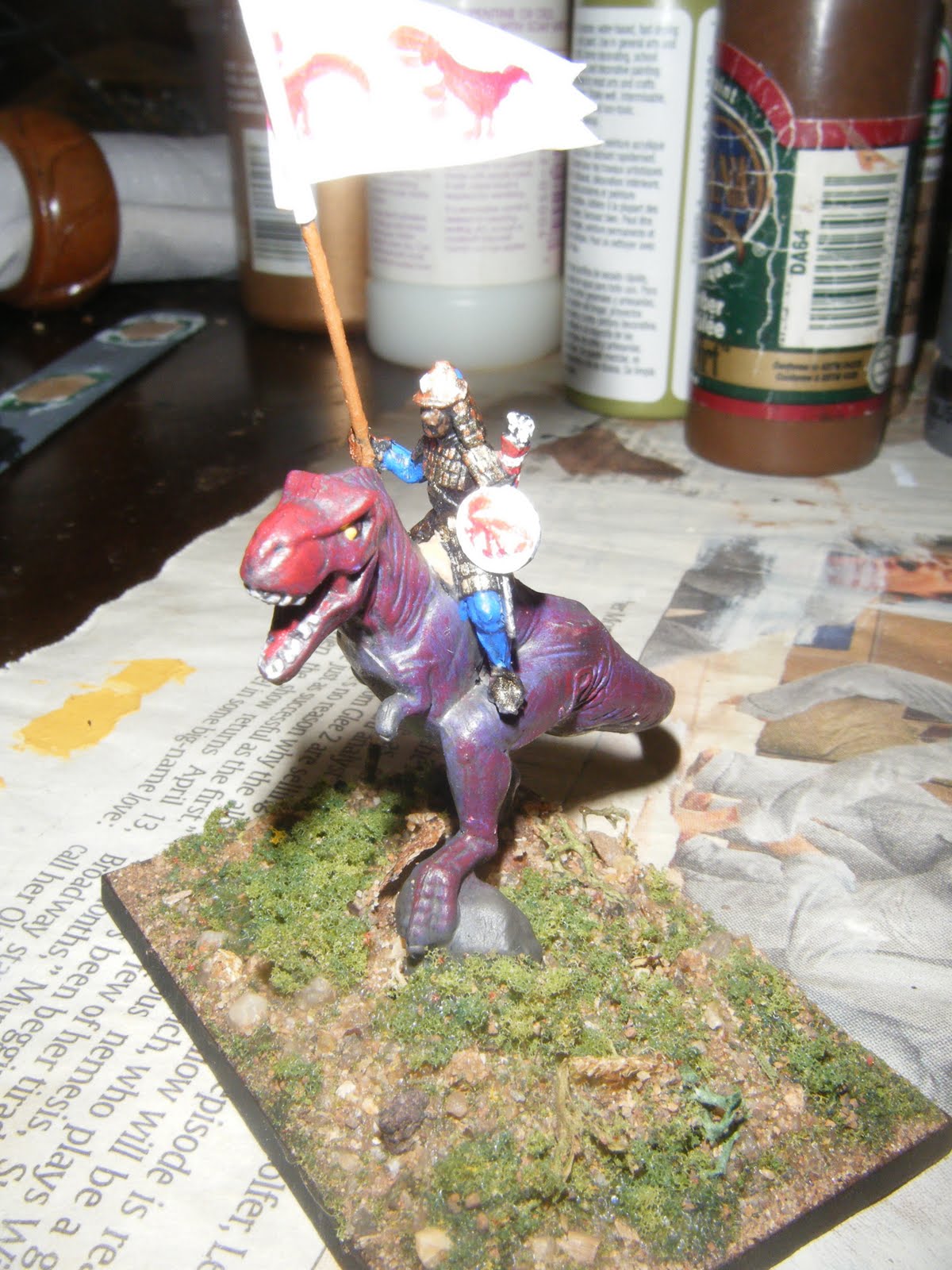
One figure I did get done before heading out was this guy, intended for a dinosaur-themed army for Hordes of the Things.


Here he is with a couple of other stands. The tyrannosaur and the riders' raptors came from a Jurassic Park III boardgame. (Incidentally, if anyone has a copy of "Jurassic Park III Island Survival Game" sitting around, let me know--I could use a couple more raptors.)

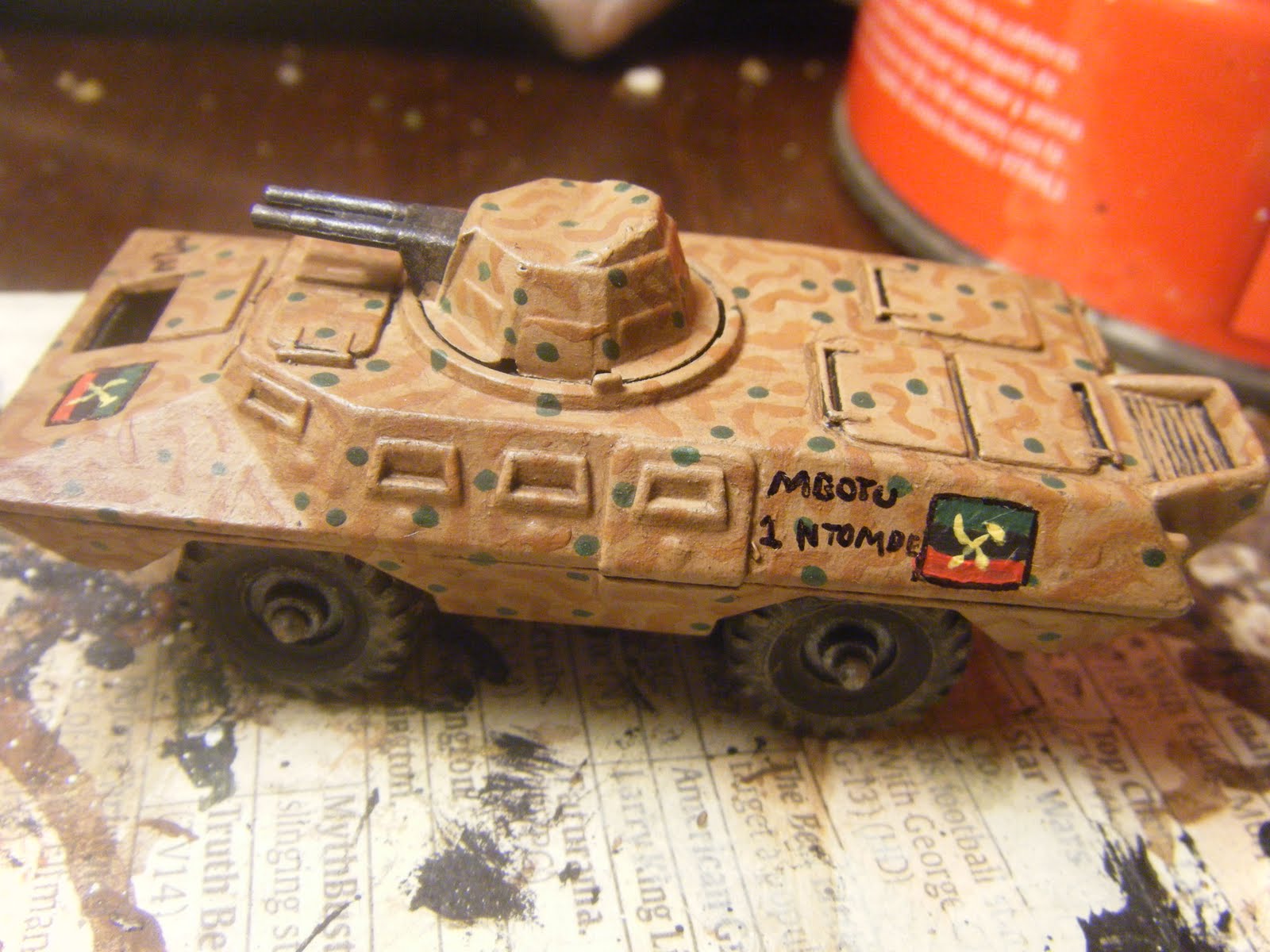
Finally, we have a couple of stands of Mbotese militia. I picked up a few scruffy die-cast trucks on Ebay to build additional technicals, but I'm seriously lacking appropriate heavy weapons to arm them. In the meantime, these guys are pretty entertaining to paint.


So what's next? Well, the Hordes army is almost done, so I may end up playing a bit of that. Mbotu needs more work if it is going to have any shot at liberating its unsuspecting neighbors from counter-revolutionary oppression. And I have a second Bronze Age army to finish up as well--I haven't painted a chariot in a while...

Friday, July 15, 2011

Fun with technicals

One of the reasons I am so enthused about this modern Africa project is the prospect of constructing technicals. Having completed my first regular unit for the Mbotese Army, I decided that I would do up a militia unit next. That means it's... Technical Time!

(Alright, the pictures should make it clear, but for anyone not in the know: a technical is a vehicle, usually something like a pickup truck, that has been modified to carry some sort of weaponry--machine guns, anti-tank weapons, or whatever else you can buy, beg, borrow, or steal.)

Here's some shots of my early mock-up, before painting. The figures are Caesar "Urban Resisters," the truck is from God-only-knows. It says "Made in China" on the bottom, and it's seem some rough use. Perfect technical fodder...


And here's the mostly-finished product. (May do some touch-up stuff on the base before I give it the final spray coat.)


Wednesday, July 13, 2011

The People's Republic of Mbotu

After a brutal and protracted guerilla war, the Marxist Succession Alliance has overthrown the colonial government of the tiny Central African country of Transequatoria, and proclaimed itself the People's Republic of Mbotu. A new flag flies over the capital of Ntomde: green for the north, black for the south, red for the workers and peasants!

But forces both internal and external threaten the stability of Mbotu. The Muslim tribesmen of the north were willing to help the MSA throw out the Transequatorians, but now tensions are on the rise between the tribes and the new government in Ntomde. And a group known only as the "Chosen Intervention Phalanx" has been staging incidents on the border with neighboring Zoote. Surely these provocations cannot be allowed to go unpunished!

When it comes to wargaming, I tend to prefer imaginary countries to real ones, so when I first ran across the rules for AK47 Republic, with its randomly generated flags, countries, and faction names, I was intrigued. Years ago, my father put together a generic modern game, with Matchbox vehicles and 20mm plastic troops, but using a different set of rules. As a matter of fact, those figures got hauled out for a game fairly recently--although they're getting kind of shabby these days. (Hadn't figured out techniques for painting soft plastics yet.) At times I've considered adding troops to that project, but never got very far.

But it wasn't until this past weekend that I finally decided to start working on an actual AK47 army of my own--as I mentioned in my last post, I picked up a couple of boxes of figures and some random vehicles at Historicon. I've been supplementing these with a few random figures dredged up from my childhood, mostly guys who I've identified as Esci Spetsnaz, and some vehicles. 

I also knocked together a building; I've seen the "corrugated cardboard roof" described in a couple of places, and it turns out it's not that hard to do. Unfortunately I must have misjudged the size a bit, as the roof is missing just a little overhang on the ends.


Sunday, July 10, 2011

Historicon 2011

In many past years, the arrival of the renowned Ross Macfarlane at our house has marked the beginning of several days of frantic terrain building, as we scrambled to complete the scenery for a convention game. However, for once we were prepared; the fortress had been finished on schedule, so we had the chance to run a playtest game before Historicon to see how the siege rules would work before releasing them on the unsuspecting public.

As it happened, for the purposes of the playtest I was tasked with attacking the fortress, and I must admit I rather made a botch of it. I managed to lose an entire battery of siege guns to a well-timed sortie from the fortress, and it took me several weeks of in-game digging before I could position my remaining cannons to breach the walls--and after all the waiting, I threw my final assault in too soon, and was bloodily repulsed!
Top: My trenches approach the wall.
Bottom: Assaulting the wall. Note that my own troops (in the orange coats) are actually on the opposing side here...)

Thursday morning we packed the fortress and all of our trenches and batteries into a couple of medium-large boxes and set out for Historicon, held this year at the Valley Forge Convention Center up in Pennsylvania. We had five games to run over the course of the convention; three of them siege games. The first game, however, was a more open battle beneath the walls of the fortress, as a train of supply wagons attempted to reach the gate without being caught by the enemy. In the end, they were halfway successful--three of the wagons made it to safety, but the others were overrun by a last-minute charge from some Rosish light infantry...


Top: Wachovian infantry fan out to protect the convoy.
Center: Hussars move forward. In the background, Wachovians trade fire with the white-coated Stanzbach-Anwatsch infantry.
Bottom: Schoeffen-Buschhagen dragoons sally forth from the ravelin.

Thursday evening I had the chance to play in a little inter-war Mexican skirmish. Unfortunately, the rules being used did not scale up well to a six-player game, although I'd be willing to give them another shot in a smaller setting. As it was, a dozen figures per player turned out to be too many when each one has to  be rolled for individually to see whether they move in a given turn, and when one unlucky roll can end your turn abruptly. After four hours, my cavalry had not made it to the center of town, and I saw no combat the entire game.

 Friday morning was the first of our siege games, and I was drafted to help Dad defend the walls. Two gentlemen showed up to play the attackers, and quickly went to work digging saps and parallel, even as their guns silenced our cannons on the walls. Unfortunately, we ran short of time before they could dig breaching batteries or attack the walls, but given our lack of artillery support at that point, they could very well have succeeded.


Top: The Wiegenburg company man the central ravelin.
Bottom: Rosish artillery, backed by the North Polenburg 1st Regiment, occupy the first parallel.


A sequence showing the progress of the besiegers' works and our own dispositions.


Friday evening, we ran the game again. This time my brother William helped me command the fort's defenders against a less lucky pair of attackers. William showed a remarkable knack for picking off the engineering officers and dismounting enemy artillery pieces. After a general sortie disrupted construction of the third parallel, the attackers sent troops into the covered way--culminating in an assault on the central ravelin, where the Wachovians narrowly beat back the Queen's Foreign Regiment of the Rosish army.


Top: Our forces emerge from the covered way to attack the troops digging the third parallel.
Bottom: Wachovians and a few surviving Wiegenburgers hold back the Rosish hordes.

If I had not been holding the fortress, I would have liked to play Matt Kirkhart's Megiddo game, featuring his stylish homemade figures. I enjoyed his earlier Greeks vs. Persians, so a chance to play my favorite period would have been doubly welcome. Alas, the voice of duty called, so I have to content myself with a few pictures:


Saturday morning I was compelled to hold the fortress by myself, as my brother was running his own game--LEGO pulp adventures for kids. This time my gunnery was much improved, but when the inevitable assault came, we were driven back to the walls. As it was, I wish we had had time to run that game through to its conclusion--I had enough guns and soldiers left that I think I could have held them off if they tried to storm the walls, but they had actually managed to plant breaching batteries up at the edge of the covered way. Unfortunately we had to call the game at that point,  as a moral victory (at the very least) for the attackers, since no other team all weekend had managed to make so much progress.

Top: Saps zigzag forward, supported by short stretches of parallel.
Bottom: MacDuff's Fusiliers mass for the attack on the covered way.

For the fifth scenario, a relief of the fortress is attempted. This time there were sufficient players that my services were not required, so I was in fact relieved. This freed me up to scrounge through the flea market, where I found the most remarkable zeppelin for a mere $5. This I passed on to Chris Palmer, co-author of the popular G.A.S.L.I.G.H.T rules for pulp and Victorian Science Fiction, and a virtuoso scrounger and modeler himself. (If anyone can identify the zeppelin in question, please let me know. My research suggests that it is a toy associated with the Yu-Gi-Oh! cartoon series, but a quick web search was unable to turn up another one.)
Top: Dad explains Charge! to the newest batch of players.
Bottom: The mysterious "Duel Disk" airship.

We wrapped up the convention by participating in the "Iron Paintbrush" competition, in which teams of three are given paints, supplies, and a variety of figures and plastic bits, and must use these to construct a diorama that incorporates a randomly selected color (magenta), pattern (stars), terrain element (snow) and theme ("It hurts when I pee.") No doubt you can imagine the sort of entries that resulted, but no doubt a few pictures will be appearing on The Sharp End of the Brush as soon as Dad gets around to it.

And of course, no convention is complete without a new project. I picked up a box of Caesar Miniatures'  "Urban Resisters" and some Revell Vietcong to form the core of a modern Africa game, most likely using AK-47 Republic. Along with a few elderly vehicles from the flea market, these will be the beginning of the Marxist Succession Alliance of Mbotu...