Tuesday, February 14, 2012

Maps, part IV

Yes, it's that time again!

I've been away from my painting table for the last couple of weeks, and now that I'm home there will probably be a brief delay until I get production started up again. Also, you may expect some Cossack-related griping in the near future.

In the meantime, here are a few more alternate history maps. Remember, these maps are fictional, do not depict real history, and should not be used as resources. Moreover, I do not intend them to make any political statement about the owners of any given piece of land, now or at any time in our past.

That being said, here's the first map: an "ironic reversal" of the Boer War.

Towards the end of the sixteenth century, a group of London merchants were granted permission from Queen Elizabeth I to form a company for trade with the East Indies--the predecessor of the British East India Company. In OTL, all three ships from their second expedition were lost at sea, but in this timeline, one survives, and on its return the captain advises his employers that a supply station should be built to facilitate future trade. It is several years before the company's backers can find the funds, but eventually they follow through on the captain's recommendation and the settlement of Goodhope is founded on the site of OTL Capetown.

The colony grows slowly but steadily, and bit by bit English settlers begin to push into the interior. Puritans and other nonconformists account for a disproportionate percentage of the new arrivals, and many of them move beyond the region of official government control. Relations with the native peoples are complicated and often devolve into violence. The city of Willemspoort is founded further east along the coast as a supply station for the Dutch, marking their first official presence in the region.

Despite their early advantage, the English eventually falter, and in the aftermath of one of the European wars they are stripped of many of their eastern colonies, including Goodhope and the outlying settlements, which are handed over to the Dutch. The unofficial farming and ranching settlements of the interior are left mostly to their own devices, although they begin to receive a steady influx of people from the coastal settlements who are dissatisfied with the new Dutch authorities. Known as "Rovers," many of them push east to the Limpopo or north and west across the Kalahari, provoking fresh conflicts with native tribes, particularly the Zulus. A series of independent English-speaking republics are formed across the interior of South Africa, not all of the recognized by the Dutch authorities in Goodhope. Dutch immigration to the so-called "Rover republics" is resented by the English-speakers, and tensions are only aggravated when gold and diamonds are discovered in the region. In early 1901, violence breaks out between Dutch settlers and English Rovers in one of the disputed regions. The Governor-General in Goodhope moves to assert Dutch authority, while the Rover leaders appeal to the Portuguese, who have tacitly lent their support...

Next up, alternate alliance systems in the 19th century lead to a different World War I:
Bismarck doesn't become a diplomat; he goes into law or something instead. Without him, Prussian politics proceed somewhat differently. There ends up being no conflict with Denmark over Schleswig-Holstein, but war still breaks out between Austria and Prussia in 1866. This war ends up going on longer than it did in OTL, without Bismarck's moderating influence, and some of Austria's allies in southern Germany are forcibly incorporated into the new German Federation. This, in turn, averts the Franco-Prussian War: the French are on their guard and the Prussians are busier holding together their new country. The French buddy up with the Austrians in a sort of new "Diplomatic Revolution," while the Germans build ties with Russia and Italy.  A Russo-Turkish war does occur, though along somewhat different lines than OTL--with Austria-Hungary more focused on the west and less well-inclined towards Russia, it doesn't end up taking over Bosnia, though Serbia and Rumania gain their official independence.

As described in the map text, a major war breaks out in 1900, between the Triple Alliance of Germany, Italy, and Russia and the Franco-Austrian Concert. The Ottomans and the British both end up joining the Concert, as the map colors suggest--the former to get back at Russia, the later partly because of the Great Game and partly due to worries about Germany. British intervention on the continent is limited to a few token forces, but the British navy has a grand old time against the Italians in the Mediterranean, and there's fighting against the Russians in Persia and Afghanistan as well as against the Germans in their couple of African colonies. (Almost anything is preferable to the trench warfare that engulfs much of the continent--it's pretty much like our WWI but without tanks and only a few primitive airplanes towards the end...)

And for the third one, it's back to Africa for a look at a rather dystopic Kingdom of Kongo:
The Kingdom of Kongo was one of the few nations that managed to avoid European colonialism; a series of smart and fortunate kings managed to play off the English, French, Portuguese, and Dutch against one another, while taking over several of Kongo's weaker neighbors.

Does this mean that Central Africa is a shiny, happy place in this timeline? Unfortunately not. Part of Kongo's strategy for retaining its independence was to be too valuable for any one European power to be allowed to seize, and so the kings of Kongo ended up paying for their freedom with all the resources at their disposal--gold, ivory, copper, diamonds, and even their own people, until the end of the slave trade. As the 19th and 20th centuries progressed, Kongo began to develop its own industries, and with the European nations distracted by wars at home, Kongo emerged as a regional power of its own. A timely declaration of war gave the Kongolese an opportunity to snap up some territories in the interior during the subsequent peace conference. These new territories, dubbed "special resource zones," are being ruthlessly exploited in an attempt to cement Kongo's status as an industrial power. Likewise, "Kongolese Catholicism" is being imposed at bayonet-point throughout the empire, with Muslims, followers of traditional religions, and Protestant converts and missionaries being targets for violence.

And here's a special bonus map! The story behind this one is not mine; instead, you can check it out here.

Friday, January 20, 2012

Soldiers of the Rzeczpospolita

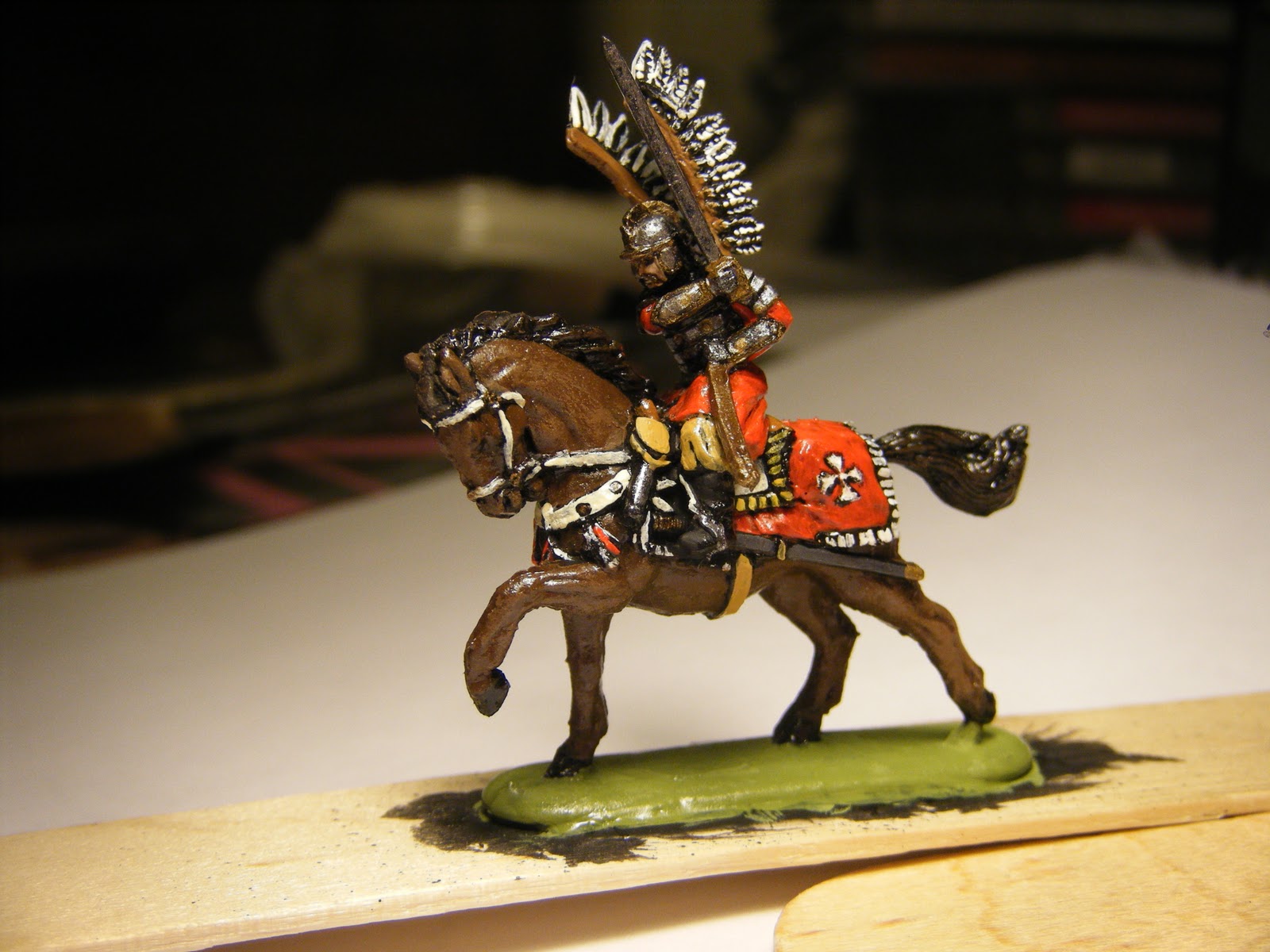
Things have been moving along pretty smoothly on my latest project. I finished off my German-style infantry earlier this week, and a second stand of winged hussars today:

Front view

Rear view

The fellow in the center is distracted by something off to his left.

See! Two stands!

Next up are more infantry, with more of a native Polish look to them. They're actually some of Zvezda's Streltsi, but with the hats and beards trimmed down a little. In retrospect, it might have been easier to get at the beards before I glued the separate arms on. Oh well. 

A sneak preview.

Dad and William are out of the house this week; William has the US Figure Skating Championship in San Jose, where he's competing in ice dance at the novice level. (I think. Skating has like half a dozen levels and I sometimes have trouble keeping them all straight.) Anyway, hopefully he will have as much success there as he has had at Hordes lately! And I'll have plenty of time to paint with no distractions. Handy, since my boxes of Cossacks and long-awaited Mongol heavy cavalry finally arrived today...

Sunday, January 15, 2012

Swords of the Dark Empire: Revenge of the Lich King

Well, it was a bad day to be good as William's forces triumphed over both my nomadic horde and a ragtag band of misfits in two separate games.

Game one, just before the armies meet meet. Note the impassable marsh right behind my main line of battle.

The first game got off to a promising start as one of my behemoths overran his Blades and my general cut his way through two stands of Hordes in quick succession, creating a nice gap in the center of his line. At the same time, my right-hand yak was thrown back by his Hero general. This seemed like an excellent opportunity to surround his general and end the game in one fell swoop, so I moved my yakatherium back up into contact and brought my own general around to cut off his retreat. Unfortunately, at even odds he repelled my yak once again, leaving our generals to face each other--and he managed to bring up another unit to block my retreat. So I lost my general, but since I was still ahead on points, the battle continued--and of course I rolled a 1 for pips the next turn, so my units stood idly by while his Hero general chased my yak into the impassable swamp. So much for game one.

The field at the start of game two.

Game two began with a rather extended scuffle between our shooters in the woods, with some surprising upsets on both sides. My knights and my flyers were happily kicking apart his infantry when the news came that the stronghold had fallen! Oh no! Turns out that darn Hero General of his (who had started out on his extreme left, hence my little cluster of units on the right flank in the above picture) had  slipped past my archers in the woods and captured the castle. Oh well.

Tomorrow I should have the rest of my stand of German mercenary musketeers painted up. Then it'll be more winged hussars, and then another stand of shooters, this time converted from some of the Zvezda Strelets infantry, and by the time those are done hopefully my shipment of Cossacks will have arrived...

Friday, January 13, 2012

First winged hussars!


Yep, not a lot to add here. For those who don't recognize them, these are Polish Winged Hussars from Orion. Pretty entertaining to paint, though the figures aren't quite as clean and smooth as some other manufacturers. My planned army list will have two more stands of these guys for the Polish sides, including the general. As for their opponents, the Cossacks are still in the mail somewhere, so next up I'll be doing a stand of Polish infantry. (Actually German mercenary musketeers, with the figures being from Revell's Thirty Years' War Swedish Infantry...)

Monday, January 9, 2012

Things that go bunyip in the night

Well, I figured I should tie up some loose ends before launching into my new Polish venture, so I made a push to clear some of my painting backlog. First up is this guy, from the Caesar Adventurers set.


Some may call him a troll, others an ogre. Magic: the Gathering players might think of him as an Orgg or a Vizzerdrix. But I call him a bunyip, even though he bears no particular resemblance to the bunyip of Australian legend. (In an amusing coincidence, I saw a day or so back that I am not the only miniatures blogger to have painted one of these figures lately...)

Next, I based and painted up that batch of plastic wolves that I picked up over the weekend. They're rather large for lupines, so maybe they're actually direwolves or wargs or something. In any case, they'll help fill out the Orc army some day.


Finally, I finished up my last stand (for now, at least) of Mongol horse archers. (Shown here with another stand that I finished over the holidays.) As with the others, these guys are a mix of the various Mongol sets currently on the market.


And that gives me a complete army! (To be supplemented with more heavy cavalry at some point.) Next: time to begin work on my first winged hussars...


Friday, January 6, 2012

Into a new year with Fire and Sword!

2011 was a pretty good year for miniatures, if nothing else, and hopefully 2012 will be likewise. The gaming room has still not been entirely reconstructed following a bout of remodeling, so the near future may continue to be aimed at expanding my various Hordes of the Things armies and other 1/72 scale work, though I will no doubt get back to Wachovia at some point.

I have managed to get in one actual miniatures game this year. Last weekend I had some college friends over for some gaming, and while we mostly stuck to board games, I did inveigle one of them into trying his hand at Hordes--where he promptly trounced me, despite never having played before. He led the Dinotopians, while the Antediluvians under my command maintained their proud and ancient tradition of defeat. Only a couple of blurry pictures survive to record this battle...

Playing a round of Fast Food Franchise.

My Spears and Magician attempt to hold a hill.

After my Magician got snapped up by his tyrannosaur-mounted Hero and my stronghold had fallen, I realized that I had forgotten to deploy my two Riders. Ah well. Might not have made a difference anyhow...

I'm still one stand short of my goal on my Mongol project, not counting figures I have only coveted without (yet) purchasing. Unfortunately, there's a decent chance my miniatures energy is about to get diverted. 

For some reason I woke up at like 4 a.m. this morning with a terrible thirst... and an idea for a pair of matched HotT armies based on one of my favorite books: With Fire and Sword.

Poles:
Knight General (Prince Yeremi) @ 2 AP
2 Knights (winged hussars!) @ 2 AP each
2 Riders (lighter cavalry) @ 2 AP each
2 Shooters (musket-armed infantry. Could also be Spears.) @ 2 AP each
Artillery (cannon) @ 3 AP
Sneaker (Pan Zagloba in disguise) @ 3 AP
Hero (Pan Yan, Pan Longinus, Pan Michal) @ 4 AP

Cossacks:
Lots of Hordes and maybe Shooters and an Artillery, and a fair number of Riders.
Sneaker (Bohun)
Hmyelnitzki (could be a Hero General, but given his somewhat tangential role in the events of the book, could be fun to play as a God or Dragon--dangerous, but not dependable...)

In any case, the inspiration comes from the two characters represented as Sneakers, a unit which is mostly restricted to interacting with generals, strongholds, and each other... which pretty much matches their actions in the book.

The good news is, I already have some of the figures! I already have a couple boxes of Orion Polish Winged Hussars sitting around waiting for this sort of opportunity, as well as a fair number of the old Revell 30 Years' War figures. Better yet, I have some figures which were passed on to me by Ross Macfarlane:


These guys are an intriguing mix, largely converted from the aforementioned Revell types, but with a leavening of others from all over. In some cases, the years have not been kind--the paint is peeling and some weapons are bent. But hopefully some of them will be fit to see service with a little work, and the wagons will be excellent start to a Cossack stronghold...

 I'm not sure what these fellows were, but I know what they will be: Cossacks!

The "bad" news is that a number of excellent 1/72 scale sets for this period have come out in the past few years, so I will probably be compelled to buy a few boxes of Orion and Zvezda Cossacks to help build up some opposition. It would be best if I were to sit down at some point and carefully plan the minimum amount required, but in any case it may mean that my more fantastical plastic armies may end languishing for a while.


(Although when I do get back to them, I have these plastic ex-Mage Knight wolves I picked up at my local game store this afternoon, to add a little variety to the Orcs...)

Thursday, December 29, 2011

It yurts so bad...

While my Mongol troops are nearing a state of completion, no self-respecting Hordes of the Things army is complete without a stronghold of some kind--a base of operations to defend when the occasion arises. In the case of my Mongols, this means one thing: yurts!

(OK, just in case a dedicated Mongol expert comes along: yes, the actual Mongol word for these things is ger. But yurt is so much more fun to say, and besides, these aren't exactly historical Mongols.)

A quick survey of the internet failed to turn up any satisfactory commercial yurts in 20mm, and the first few results for "model yurt" seemed to be geared towards kids' projects about constructing a functioning yurt starting with the proper latticework walls made of toothpicks or whatnot. For wargaming purposes, I don't really care about the internal structure of my yurts; they just have to look yurt-like. I figured I ought to be able to knock together something out of cardboard and whatnot that would suit my needs well enough.

Turns out this is somewhat easier said than done. It took a bit of work with a compass, protractor, and calculator before I finally came up with a template that would yield the distinctive shallow cone shape of a yurt. But to save you all the trouble, I am reproducing it here!
The long strip should be 260mm long, with the tab at the end being 9mm of that. The circle has an outer diameter of 45mm when flat, and 40 degrees is the angle of the arc removed.

I cut these out and taped them together to form the underlying structure of my yurt, like so:

 Here I've taped the two sections together. The horse and his buddy are just for scale.


It had been my intention to cover the cardboard with a layer of papier-mâché to give the surface some texture and to conceal the join between the two cardboard sections, so I give this a shot, using tissues as the basis for my papier-mâché mix.


As it turned out, tissues were too thin and became waterlogged, giving the yurt a sort of distressingly lumpy look. In addition, the water began to soak the cardboard as well, such that it looked like it was beginning to lose its shape. I applied a layer of brown paper towel over top, hoping to improve the texture issues, but results were sort of mixed. Also, the yurt ended up looking like a biscuit of some sort.


At this point, I figured I might as well try painting the thing. I glued on a thin rubber band to represent the cords that seem to help the yurt maintain its shape. A look back at some pictures of yurts suggests that there really should be two of these. I also glued on a doorway made from a bit of plastic card. (Actually a section of a room key from a hotel...)


With several coats of paint applied, I ended up with something that doesn't look too terrible.


I may do a second one of these at some point, but I'll have to consider how I want to modify the design. The tissue-mâché was definitely a mistake, I think, so I might leave that part out entirely. It would be nice if I could find a way to cut the yurt out of a single contiguous piece of cardboard, but I'm not sure that would be geometrically feasible. Next up, though, I have a couple more stands of riders to finish off--one of them is visible off to the side in this last picture.