Wednesday, June 27, 2012

Reviewing the troops

I have gotten at least a couple more units painted recently--first, after weeks (months?) of procrastination, I finally finished up the third Assyrian chariot.


Second, I did some more "paint conversions," turning Robin Hood archers into generic biblical archers.  Between the simple poses and the subdued paint scheme, these were some of the least-exciting figures I've painted. I've got another six in my queue somewhere, and they should be a snap, if I can just find time and motivation to sit down and work on them.


 I have hopes of putting a game on this weekend, which will nominally be a playtest for Historicon. To that end, I've been working on getting the back room into usable condition; last night Dad and I got the tables set up again and an appropriately brown groundcloth put down. With the table temporarily clear, I took advantage of the opportunity to get a few shots of all the troops together. These ones are all mine, though of course Dad's Egyptians will also be taking part in this weekend's games.

Here we have the chariot corps: one squadron of Assyrians on the left, and three each of Mitanni and Hittites.

Here we have the infantry, lined up by contingent.


And here's everyone together.


Now, back to cleaning/thinking about rules and scenario design...

Thursday, June 14, 2012

An auspicious occasion & a mechanical crustacean

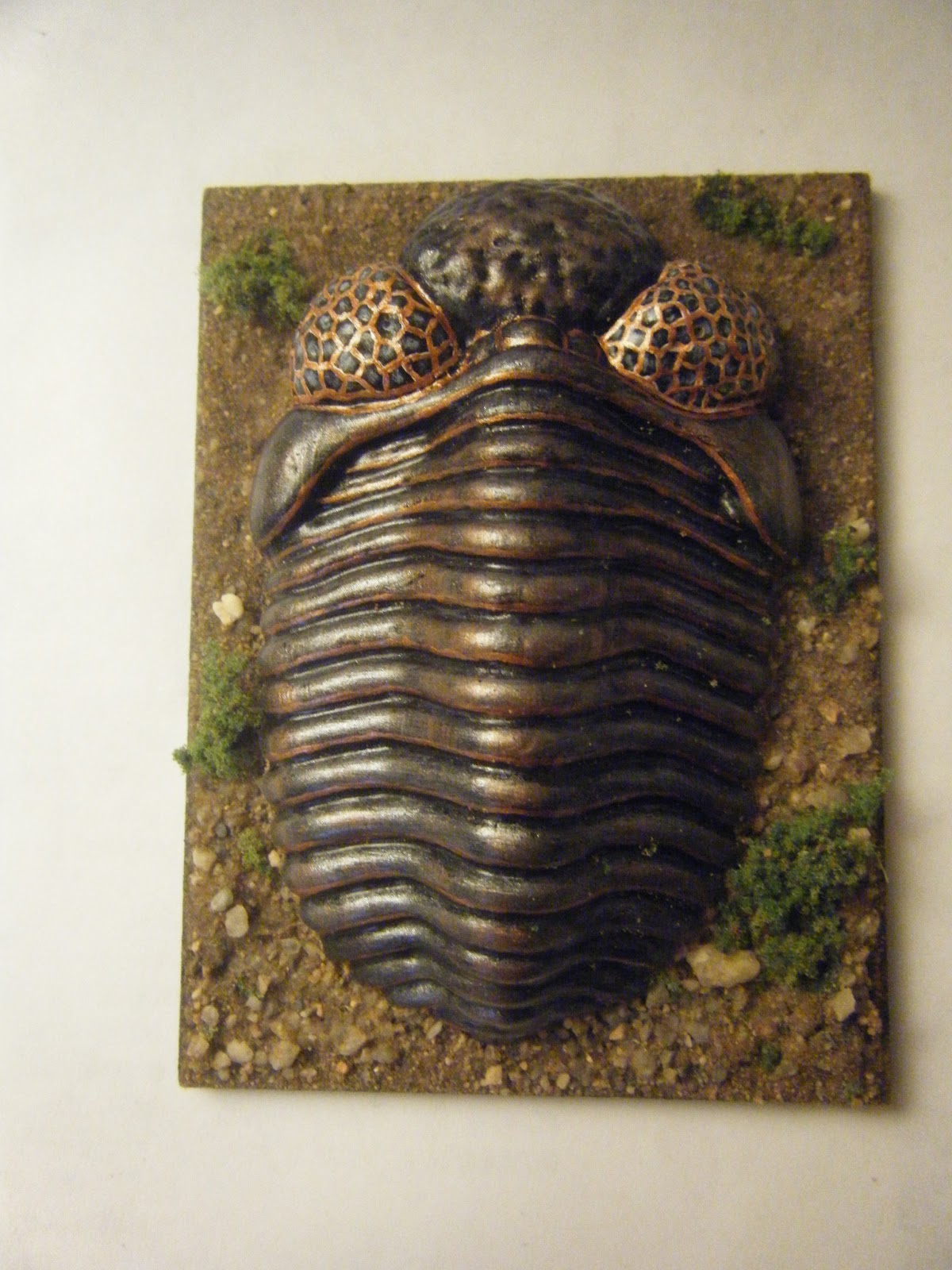
Well, first of all, the latest from my painting bench--inspired by my recent games, I finally hauled out one of the mysterious plaster trilobites I picked up at Cold Wars this year and got it painted up as a Behemoth for the Antediluvian army. The metallic paint scheme suggests that it is some sort of construct, powered by some combination of ingenious clockwork, the mystic arts of the now-submerged Antediluvian homeland, and the distilled essence of rock oil. In any case, it should add a bit of flexibility to the Antediluvian army list.

Top view

Side view

Alongside some other Antediluvian units.

Secondly, today, June 14th, marks the one-year anniversary of this blog, so to mark the occasion I figured I would share a few tidbits of information drawn from the handy pile of data collected and made available to me by Google.

As of the time of writing, this blog has garnered 7,350 pageviews, and this post will be #52--an average of one per week. The top five referring sites are google.com, sharpbrush.blogspot.com, facebook.com, alternatehistory.com, and paulsbods.blogspot.com. The vast majority of viewers are in the United States with 4,010 out of 7,350, followed by the United Kingdom, Canada, Russia, Germany, France, Spain, Poland, Italy, and Australia. Historicon 2011 is currently the individual post with the most views, (many of which seem to come from people searching for some variation on "duel disk") while Digging in currently has the least.

However, what I tend to find most interesting are the Google search terms. The most frequent of these is, unsurprisingly, "junkyardplanet.blogspot.com," but it is currently being trailed by "hyborian age map" and "polish winged hussars orion." At least in the latter case, I can be pretty sure that whoever it was found what they were looking for. (On the other hand, three people have come here in the past month via a search for "planet asses." I fear they may have been sorely disappointed.)

So, to everyone who has dropped by at some point--thank you for visiting, and I hope that you found something of interest, if not necessarily what you were looking for! With any luck, I will be in a position to mark this anniversary again next year, by which time I will no doubt have painted numerous figures and played numerous games, and recorded the results here on this blog.

Monday, June 11, 2012

A couple of quick games

Dad was of a mind to play a game or two this evening, so we hauled out some of the 20mm figures for a couple of rounds of Hordes of the Things, featuring a couple of my armies and some of the Punic War figures press-ganged into providing some opposition.

Dad moves his elephants forward.

The first game saw the Antediluvian army (mostly Spears, backed up by a Magician and a couple of Riders) on the offense up against a more diverse "Carthaginian" force with some elephants as Behemoths and a couple varieties of mercenaries/allied cavalry as Knights and Riders.

View from behind the lines.

The beginning of the battle saw my block of Spears roll forwards against Dad's Spears and Behemoths in the center, while a couple of smaller actions developed on the flanks: my Riders against his Knights and his Riders against one of my Spears and my Magician. Unsurprisingly, my Riders got pushed back and eventually overwhelmed, but with a little luck I was able to take down both his elephants and one of his Riders.

The tide turns.

Unfortunately, I got a bit overconfident, and tried attacking his Spears uphill, which lost me one of the units on the end of my line. Between that and the Knights suddenly appearing in the rear of my line, I was compelled to readjust my position, and the whole battle swung about 90 degrees. I had a brief shot at killing his general, which failed, before his Knights ran down two more of my Spears, evening up the losses. (Some poor rolling on my part there.) Luckily, just as we were preparing to make our last stand, my Magician summoned his reserves and blew away Dad's other Rider, pushing his army over the limit.

The second game saw the Dinotopians (a hit-or-miss combined arms mishmash) against the Romans Volscian Republic (mostly Blades and Spears, with a few Riders and a Knight General). Fortunately I got lucky on my initiative rolls, and was able to get my pterodactyl Flyers behind his lines while my Warbands hit him from the front. My Hero General destroyed his Knight General for a quick victory.

Warbands rush down the hill, supported by a Behemoth and some Flyers.

His Blades repulsed my Warband and now face the Flyers that have come up behind them; my second Warband has plowed through his front rank of Spears.

The Hero gets a bit of aid from his pterodactyl buddies.

Wednesday, June 6, 2012

Orcs, Byzantines, and other mythical creatures

What Norman has been painting:

"Byzantine" cavalry! (actually Strelets Russian cavalry)

Scruffy Bronze Age spearmen!

Quick and dirty Orcish archers!

What Norman has not been painting:

This third Assyrian chariot that's been sitting around for weeks now!

About a month back, I was sorting through our pile of unpainted figures and came across a whole bunch of these Strelets Russians that Dad picked up a few years ago. Looking at them, I wondered whether they might be suitable for Byzantine troops, so I cut a few off the sprues to try out. In a fit of procrastination, I got around to painting them up this week, and I have to admit I'm now kind of skeptical. I don't really enjoy painting the chunky Strelets figures as much as some others, and the more I painted them, the less Byzantine they looked to me. But no matter--they can still be troops of the Mizarene Empire. (Or Videssos, for that matter, given the shield design...)

The Orcs have also been sitting in the queue for a while, so I suppose it's good to get them out of the way as well. Some of Paul's conversions that he posted a week or two back were quite interesting--I may have to give something similar a try myself...

I also got in a couple of games of HotT with my brother recently--while there's not much to tell by way of a battle report, I figured I'd take this opportunity to show off some of his figures:

The Lich King, along with his latest toy--a Persian-style chariot.

My Mongols face off against his Arab types. We had a weird sort of Conga line situation going on here: If my Behemoth had beaten his Spears, he would have recoiled into my Riders and died. If my Behemoth had lost, it would have crushed the Spears behind it when it recoiled. Either one would have given me the last two points to win the game. Naturally, the combat was a tie.

(I did win in the end, though.)


Wednesday, May 30, 2012

Working in two dimensions

It's not often, but every once in a while I get the urge to do some drawing. This time, the catalyst was a work called Lands of Red and Gold, over at alternatehistory.com, which imagines a world where Australia developed agriculture and native urbanized civilizations of its own. After reading through all this, I got to imagining what some of the people might look like, particularly the soldiers of the various cultures. (Well, I am a wargamer, after all. (That reminds me, I should look around and see if anyone has sketched out DBA army lists for the Aururian civilizations yet...))


Anyway, this is the resulting product--I drew the people by hand, then scanned the drawings and colored them in using GIMP.

(And now, with that out of my system, I can get back to painting chariots...)

Tuesday, May 22, 2012

Maps, part VI

Another set of maps today! The usual cautions apply--no, these maps do not depict actual events. Kids, don't cite me in your research papers. (Well, I guess you can cite me if you use proper MLA style or whatever if you really want to. But I don't recommend this as an accurate source for any history your teachers will recognize...)

This first map was a relatively non-serious look at how future archeologists might misinterpret the remains left by our civilization. I realized afterwards that I was probably subconsciously influenced by reading David Macauley's "Motel of the Mysteries" when I was younger, as well as the Penguin Atlas of Ancient History, which was full of maps labeled with mysterious "Baltic battle-axe cultures" and the like.

This next one was the result of a discussion on alternate scientific revolutions. It owes a certain amount of its original inspiration to Michael Flynn's "Quaestiones Super Caelo et Mundo," though I thought his ending was a bit overly optimistic. (And I ran with a different starting point--POD, or "point of departure," as the alternate history slang usually goes.)
1331. Somewhere in the Yunnan province, a medieval Chinese farmer notices a faint tickle on his left leg. He looks down and brushes off the flea before it can bite him.

On the other end of the great Eurasian landmass, the High Middle Ages are in full swing. Universities are springing up like mushrooms after rain, and scholars like Jean Buridan are examining and questioning the Aristotelean worldview that has held sway for centuries. In this world, the budding scientific revolution will not be cut short by the Black Death--instead it will come to full flower, some two centuries before that of our world. By the late 14th century, Buridan and his pupils have compiled the laws of motion, while later thinkers expand the borders of math and science in many directions--building on the works of the Calculators of Merton as well as translations of Arabic works on algebra, the calculus is developed. Others turn their talents to astronomy, chemistry, biology, and their work is shared across the continent by a marvelous new device--the printing press.

To an observer from our world, one of the most extraordinary elements of this "scholastic revolution" is its relationship with the Catholic church, which (without the social upheaval of the Black Death) proves itself (in general) to be willing to foster and adapt to these new ideas. Many of these new scientists are also churchmen and theologians as well. This world sees no Reformation or Counter-Reformation, and while from time to time there is political disunity in the Catholic world, there is no theological disunity--across the continent, thinkers remain connected by the bonds of reason, logic, and faith.

There have been setbacks too, naturally--plagues remained frequent occurrences until sanitation improved and the germ theory of disease was developed. Of course this was too late for the inhabitants of the Americas, but overall they still fared better than in our world. The New World was discovered by powers more interested in trade than conquest--the exception being Mexico, where military orders were established to stamp out human sacrifice. An Incan empire survives to this day, though considerably Christianized, as do a few other native states on both continents.

Despite the head start in science, this world is not outrageously far ahead of us in technology--the industrial revolution did not develop as quickly as the scientific one, and there is a rather Hellenic attitude, especially in Europe, that scientific learning is worthwhile for its own sake and that applying it to the real world is slightly vulgar. (Several rising powers, in Asia and elsewhere, have no such qualms--something that is starting to alarm political leaders.) The continued relationship with the church is rather interesting--an article titled "The implications of quantum superposition for the doctrine of transubstantiation" would raise few eyebrows in this world's academic journals, and this world's equivalent of the Hubble Space Telescope has permanent staff of monks.
These last two are a pair, as should be pretty obvious from looking at them. It all started when I got to wondering what might have prevented the rise of the Assyrian empire. Then I came across the Wikipedia article on the Cimmerians, and having just read Robert E. Howard's Conan stories within the past year or so, one thing led to another...
Know, O prince, that between the years when the darkness swept over Hatti and the gleaming cities, and the years of the rise of the Sons of Ares, there was an Age undreamed of, when shining kingdoms lay spread across the world like blue mantles beneath the stars - Urartu, Aram, Phoenicia, Phrygia, Israel with its dark-haired women and temples of holy mystery, Chaldea with its chivalry, Moab that bordered on the pastoral lands of Edom, Egypt with its shadow-guarded tombs, Media whose riders wore steel and silk and gold. But the proudest kingdom of the world was Assyria, reigning supreme over the dreaming east. Hither came the Cimmerians, black-haired, sullen-eyed, swords in hand, thieves, reavers, slayers, to tread the jeweled thrones of the Earth under their horses' hooves...
The idea here is that Assyria gets caught up in a badly-timed civil war--I'm thinking the turtanu (general) Shamshi-ilu tries to overthrow Shalmaneser IV, but doesn't quite succeed--and in the process, a lot of Assyria's recently conquered territories make the most of a chance to regain independence. And now, with all parties weakened, the barbaric Cimmerians are licking their chops...


The failed rebellion of Shamsi-ilu spelled the end for the Assyrian Empire. The cities of northern Syria and Cilicia reasserted their independence under the loose leadership of the Neo-Hittite city of Carchemish, while the Urartians and Chaldeans both took the opportunity to regain recent losses. Still, the worst was yet to come. The loss of the conquered territories deprived both Shamsi-ilu and his opponent, Assyrian king Shalmaneser IV, of a valuable source of manpower. To compensate, both sides began hiring mercenaries, including many from the Cimmerian tribes of northern Anatolia. Following Shamsi-ilu's defeat, some of them returned home, but others remained in Assyrian service or settled in the northern parts of Assyrian territory. A few rose quickly in the ranks--the war had provided many opportunities for advancement, and foreigners in positions of power were nothing new. (In fact, Shamsi-ilu himself had come from the Aramean city of Til Barsib--though this did not keep the city from joining Carchemish and its other neighbors in rebellion.)

By the time of Shalmaneser's death in 773 BC, one of these Cimmerian mercenaries had risen to become a turtanu of the army, and others seem to have gained positions of power throughout the kingdom, particularly the increasingly volatile north, where presumably they remained in contact with their relatives beyond the frontier. Shalmaneser was succeeded by his brother Ashur-dan III, but Assyria's days were numbered. The Cimmerian turtanu Kanaran seized power in Nimrud, and Ashur-dan was forced to flee the city.

Kanaran's coup was the start of a new era in the Near East. Though much of the administrative structure of the old Assyrian empire was taken over intact, the new dynasty brought new vigor to many of its institutions, including the military. Kanaran carried on with the Assyrian tradition of yearly military campaigns, beginning with a series of expeditions to the north that brought most of the Cimmerian homeland under his sway, pushing west to the borders of the Phyrigian kingdom, and making tributaries of the Greek colonies along the coast of the Black Sea. Subsequent campaigns against Urartu and against some of the eastern members of the League have solidified his position with his Assyrian subjects.

To the west, the situation does not look good for the League of Carchemish--founded in the immediate aftermath of the revolt that threw out the Assyrians, ties between its diverse members had grown slack as Assyrian power waned. Now with a renewed threat from the north and east, the League also faces dissension within--a number of the southern, Aramaic, members have thrown their lot in with the rising star of Aram-Damascus, which has just completed a successful campaign against the unlikely alliance of Israel and Ammon, forcing the former to give ground in the north and reducing the latter to a vassal.

To the east, the Medes bide their time and Urartu licks its wounds. A much-reduced Assyrian successor state based out of Babylon has been forced to seek help from the Chaldeans, who are glad of a buffer state between them and the new northern menace as Kanaran I prepares for this year's campaigns...

Sunday, May 13, 2012

A rite of passage (and more chariots)

Every so often, when I gripe about the non-availability of figures for some aspect of history, Dad will remind me of how easy I have it and how back in the "old days," most 1/72 scale figure manufacturers didn't exist yet, and how people had to build entire armies out of Airfix Robin Hood figures, eked out with the occasional elephant.

Well, now I've done it myself--not an entire army, but I have done up one unit's worth of conversions, (with a second in the works) which I think is a reasonable start. As you might have noticed if you've been keeping up with my last couple months' worth of painting, I've been working on expanding my Bronze Age project (in 20mm plastic, of course) using mostly Caesar Miniatures' various sets of chariots and whatnot. One thing they lack, however, are some generic scruffy infantry types suitable for Canaanite, Syrian, and Mitanni armies--and so I turned to the Airfix set. (I'm not the first to do this, by the way--I was inspired by another wargamer-blogger, whose handiwork can be seen here.)

Anyway, I trimmed their weapons, carved away their hoods, drilled out their hands and gave them brass wire spears, equipped them with simple rectangular shields, painted on some headbands, and voilà! Scruffy Bronze Age spearmen!


And of course, more chariots. The first of these is something a little different--between my figures and Dad's, we've got a pretty sizable contingent of Sea Peoples by now, and I figured they deserved a chief. So here he is!


As for what the figures are--well, that's an interesting question. The chariot itself is one of Caesar's Hittite Chariots, but the horses are from the Mitanni chariot set. (They've had their plumes cropped off.) The driver is straight out of the Sea Peoples set, but the warrior in the back is more interesting: his head and arms are Sea Peoples, but the armored torso is from the Mitanni chariot driver.


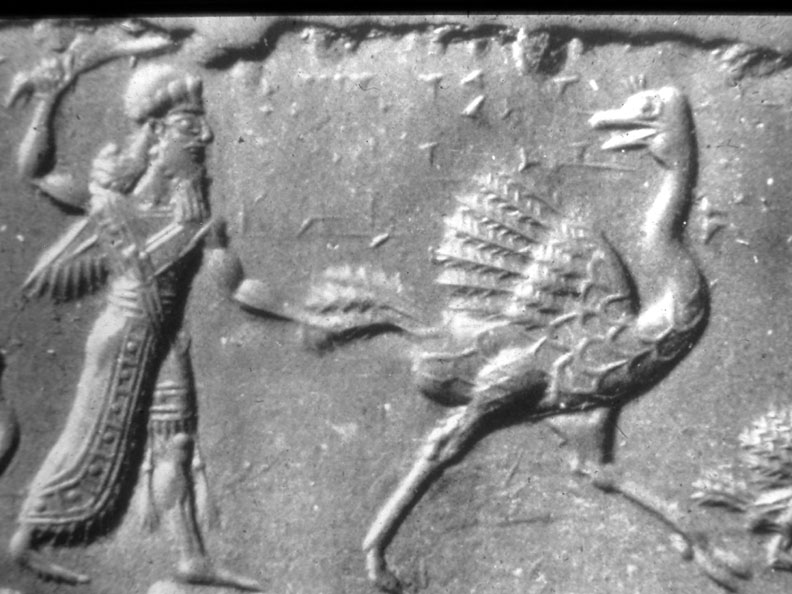
And lastly, we have the second of my "Assyrian" chariots. Yes, that is an ostrich painted on the sides--it's drawn from this Assyrian seal imprint. The crew and horses are from Caesar's Assyrian chariot set. (Fun fact #2: I realized after painting them that the green and yellow checker pattern on the horse barding is suspiciously similar to the pattern on the curtains in the room where I paint.)


One more stand of scruffy spears, two more Assyrian chariots... and then maybe I'll paint something else for a while. We'll see.