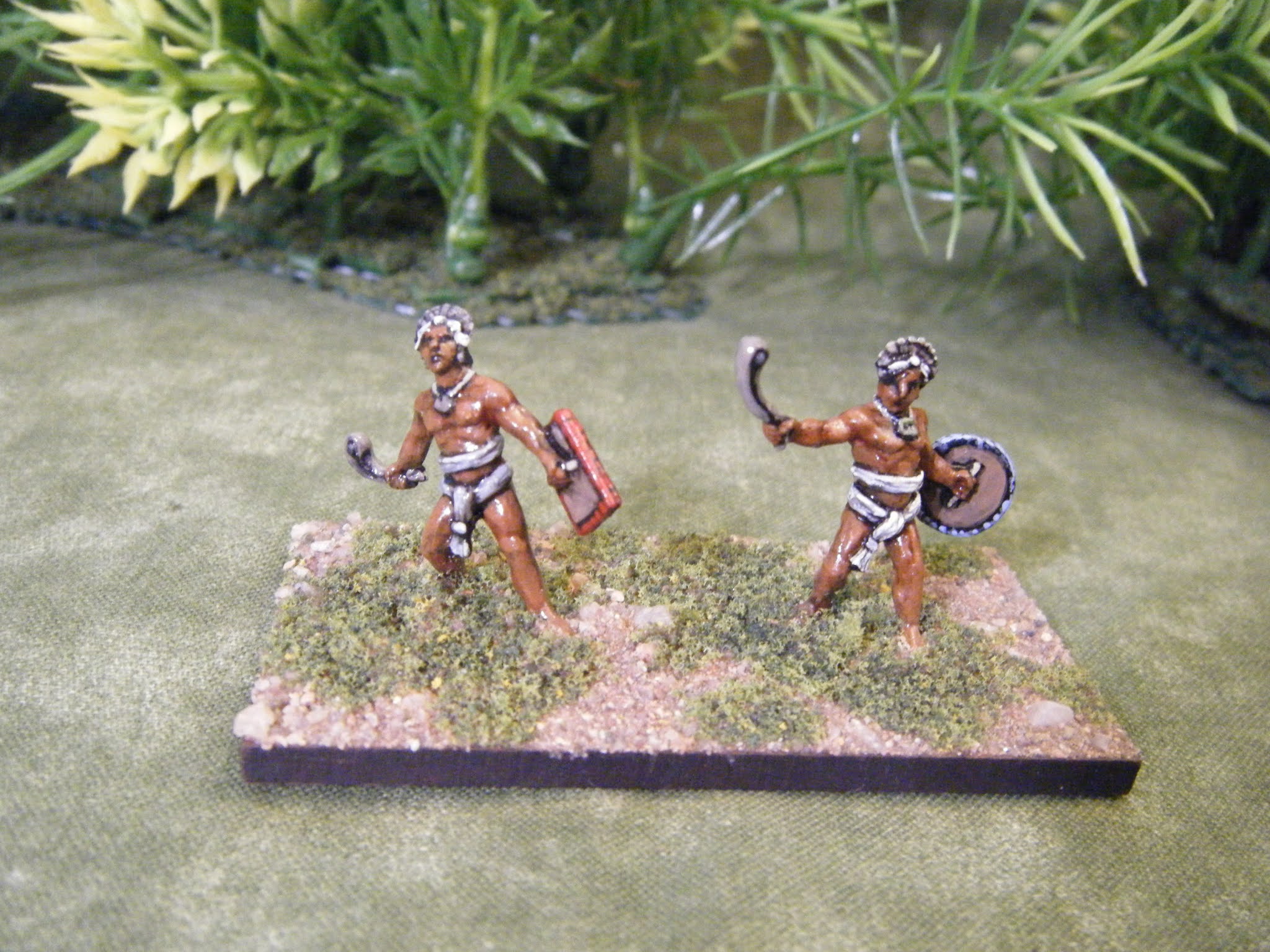
- Those fine Caesar Maya are almost certainly all based off a single color plate from an Osprey book.
- The depictions in that Osprey book are at least partly based on the famous Bonampak murals.
- The Bonampak murals date to the late Classic Era, which ended around 800 AD, at least four hundred years earlier.
Saturday, February 27, 2021
Mesoamerican DBA Part 1 - Maya
Friday, January 29, 2021
The dwarves are for the dwarves!
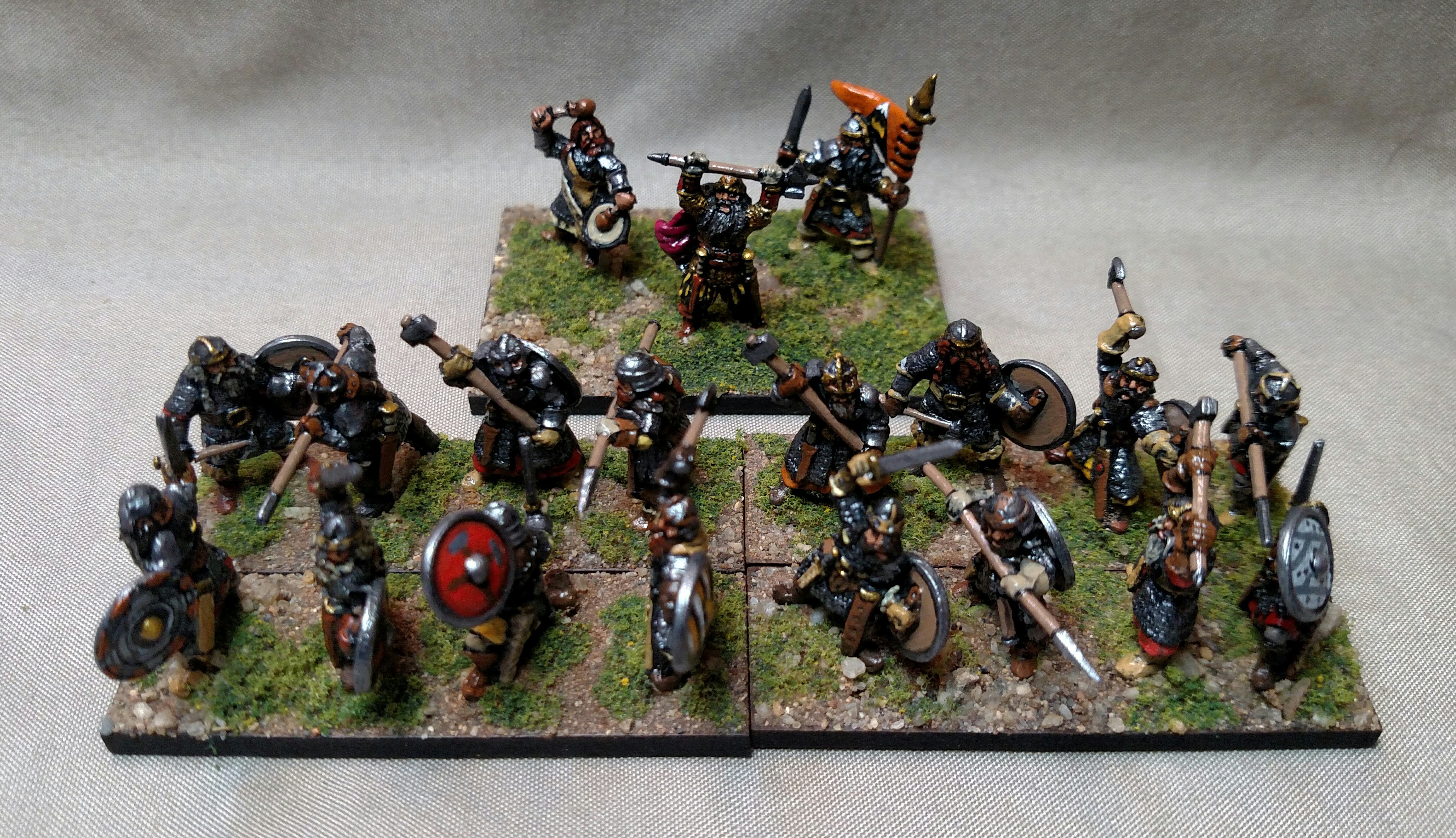
I mentioned at the end of my last post that I was thinking about what I would need to put on a version of the Battle of Five Armies from The Hobbit. This notion was sparked in part by running across a couple of dozen dwarves in my stash of unpainted miniatures (two sprues of the Light Alliance Dwarves Set 1) and wondering what I could do with those. This month, I decided to go ahead and paint them up, as a little contingent to use in Hordes of the Things or other fantasy rules.
After some consideration, I decided to kit them out in a lot of reds, yellows, and oranges, with browns and grays for some variety. I had a few spare shields leftover from the Assyrians, so I gave these to a couple of the figures that didn't have one. For shield designs I tried a few geological motifs, but others ended up with more general geometric designs or ones based on tools.
I decided to try something a little different with the bases - a lot of my existing 20mm fantasy infantry are based six or eight to a 60x40mm base, but for these I decided to try base them in groups of four on a 60x20 base. This way I can arrange them two ranks deep to match my older units, but it also gives me a little more flexibility to split them up if that would be useful at some point. (Also - I had a whole bunch of spare 60x20 bases and not so many 60x40s...)
Having finished these, I must say I am not inclined to expand them to a whole army. While the figures looked OK on the sprue, I found painting them to be a bit of a chore - many of the poses are kind of flat and the sculpting is a little chunky. Nevertheless, now I have some dwarves finished, and I expect they will be more or less stalwart allies for some of my other armies down the road.
Friday, January 1, 2021
The little things that count - wrapping up 2020
Well, I don't know quite what I expected from 2020, but this wasn't it. I do feel quite fortunate to have come through the past year unscathed, and with my family and friends generally still in good health. And for all that this was a terrible year for other things, it was a great year for me getting painting done - at some point early in January I realized I had finished an average of one figure a day, and I decided to see how long I could keep up that pace. The answer turned out to be all year - I finished yesterday with 400 figures completed. This was the first year I have kept detailed logs, but I am sure this exceeds whatever my previous record was - and it may prove to be a high-water mark for some time to come! For the fun of it, I decided to lay out everything I painted this year, all at once:
Saturday, December 19, 2020
Bronze Age DBA Part 6 - Like A Wolf On The Fold
Alright, so these guys are a few centuries earlier than the army in Lord Byron's poem, but they are Assyrians nonetheless. More specifically, this is DBA army I/25a Middle Assyrians, as opponents for my various other Late Bronze Age armies. This was a much simpler matter than my previous army, as the Assyrians don't really have any options to build out.
Assyrians arrayed for battle
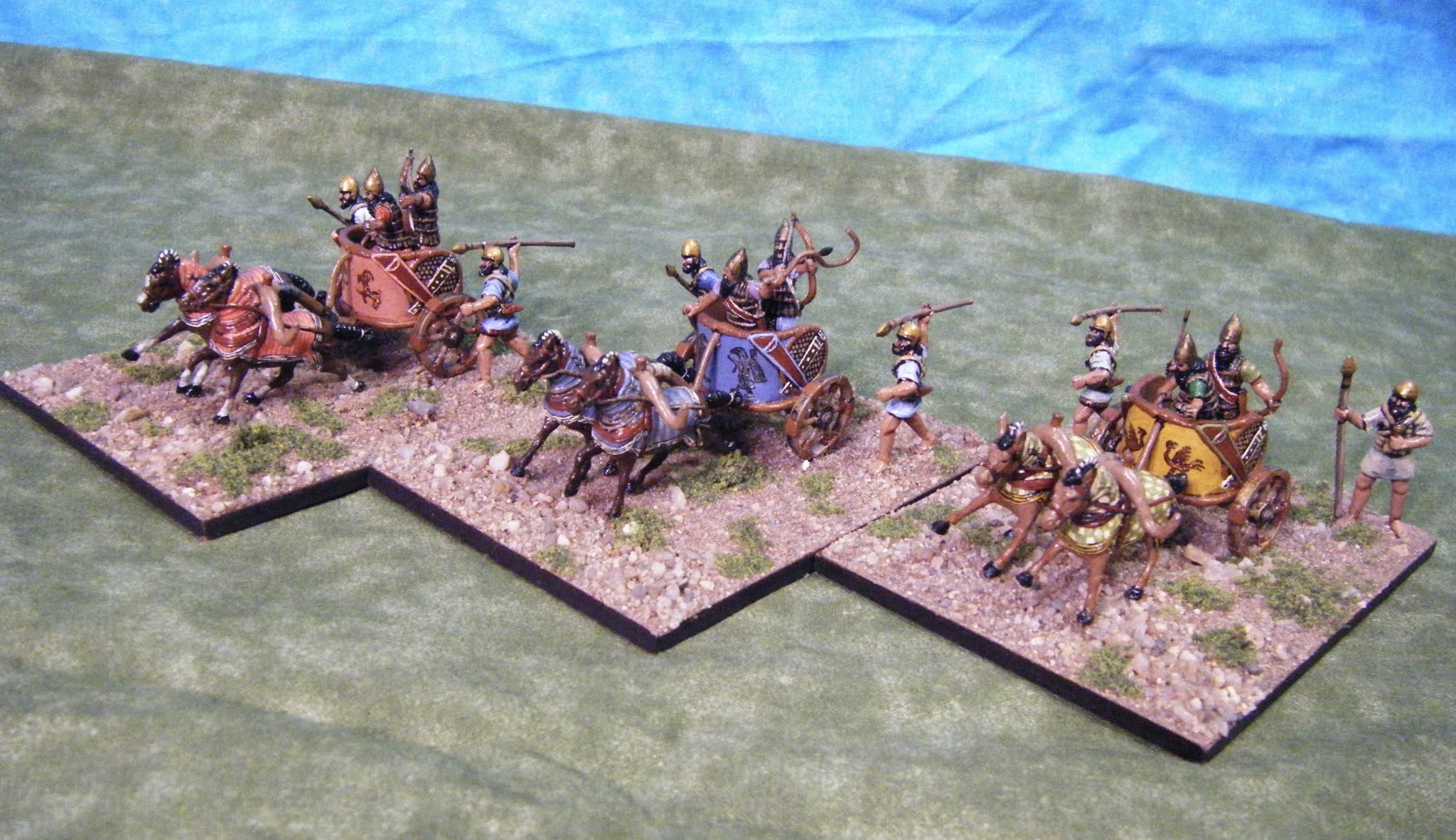
Leading the army is a Light Chariot general, backed up by three more Light Chariots. Long-time readers might recognize some of these chariots, as they were painted in a previous age, but the general is a new addition, and all four have been rebased on larger bases with supporting infantry. The chariots themselves are the trusty Caesar Mitannian Mariyannu type, but the crews and the horses are taken from the Caesar Assyrian Chariot set. (Why not just use those chariots? Well, they're a four-horse type not really suitable for this period.) The designs on the chariots are based on Assyrian seal designs from that period, and the runners are HaT Assyrian Allied Infantry.
The general and his retinue
The rest of the chariot corps
The infantry portion of the I/25a list has two units of fast Blades, four Auxilia that can be either solid or fast, and two Psiloi. The figures are mostly taken from the Assyrian Allied Infantry set as well, though there are a few Robin Hood men hidden among the spearmen. As with the chariots, I decided to use these rather than the actual Assyrian infantry that are available from a couple of manufacturers, as the armor and shields of those date to a later period. To help differentiate the different troop types, since I was working with a limited number of poses, I gave the Blades red tunics, patterned shields, and helmet plumes, while the Auxilia have white or pale blue tunics, plain blue shields, and no plumes. (Side note - the proportions on some of these HaT figures are a little odd - they have rather squashed heads but very long legs. The standing spearman in particular looks like he could find a career as a ballerina...)
"Ashsharittu or huradu" infantry as fast Blades
"Hupshu or sabe" infantry as Auxilia
Archers as Psiloi
The whole army again, from the commander's perspective
And there we have my sixth DBA army for the year! At this point I won't claim to be done entirely (since I had originally planned to stop after four armies) but I don't have immediate plans to build another whole army. What I may do next is rebase some more of my old chariots on the new larger bases; this might also let me piece together a Mitanni army by borrowing some troops from the Syro-Canaanites and/or Assyrians. But I think that will be a project for 2021.
Sunday, December 13, 2020
A Dispatch from Proxia
One of the projects that has mostly lain dormant this year are my imaginary 19th-century countries, Occiterre and Elabrün. (For more information on them and their various neighbors, please consult this map, or reference the Encyclopedia of Proxia - now available in a new and updated edition!) However, a recent hitch in my supply chain caused me to dredge up a couple of units that had sat on my desk since the end of last year, and get them finished off:
The fellows on the left are more Occiterran infantry (from Emhar's French Infantry set), but the origins of the Elabrüner cavalry on the right are a little more complex. For my Elabrüner infantry, I've been using Waterloo 1815's Austrian Infantry, but for some reason that set is oversupplied with officers - each box comes with both four officers on foot and four mounted officers. I decided to press some of the latter into service as cavalry instead. Unfortunately, the horses they come with are in a dramatic rearing pose, and I didn't particularly want a whole unit of these, so I scrounged up some spares to remount them:
Their uniforms are loosely based on this and similar images of Austrian hussars from the era (though I did not bother trying to add a pelisse):
Thursday, October 29, 2020
Orctober in two scales
While casting about for something a little different to paint after finishing up my most recent DBA army, I was reminded that this month is Orctober! As it happens, I did have some orcs in need of painting. In fact - I had orcs in two different sizes!
First up is a somewhat belated addition to my 20mm Orcish army for Hordes of the Things. It looks like the last time I painted any of these was about eight years ago, but they have seen plenty of action since then - most recently, as it happens, while on loan to my dad. At the time all that was available was Caesar's original set of orcs, but in the years since they have come out with a second set. My dad picked up a box of these a while back, and passed along to me a spare shaman, which spent some time rattling around my bits box. I finally plucked him out of there this month, and found a couple of leftover orcs to provide him a pair of bodyguards. In Hordes of the Things, he should work as a Magician or possibly a Cleric.
The other orcs are more of the Reaper Bones line, in 28mm (though these guys are probably a bit bigger than that, being pretty burly!) Reaper bills them as a Slayer, a Chopper, and a Sniper. I've been working on these much more recently, to be used either for D&D or some sort of fantasy skirmish. With these three, I should now have enough for an entire crew in Ghost Archipelago, should I so choose...
(Incidentally, you may note that my 20mm orcs are green, and my 28mm orcs are gray. Why is this? Well, green skin seemed like a natural enough choice back when I was painting my original 20mm orcs, but in years since I have come down on it a bit - orcs in Warhammer or World of Warcraft might be green, but it's a pretty unusual color for mammals in the real world. When it came time to paint some 28mm orcs, I decided I wanted something different - I wanted a color that was fairly neutral, while also avoiding real-world human skin tones. Hence, gray orcs.)
With these guys out of the way, and Orctober drawing to a close, it will be back to the Bronze Age soon. I have my eye on a sixth army, and I might be able to finish it before this year is out...
Wednesday, October 14, 2020
Bronze Age DBA Part 5 - The Fifth Column
So here I am again, with the fifth of my four planned DBA armies. Yes, that's right, there's some mission creep going on, and it's an exciting tale of head transplants and Biblical controversy! It starts with most of a box of the Caesar Arab Camel Riders and Bedouin I had left over after finishing my Syro-Canaanites. At some point I realized I could just squeeze out a I/6a Early Bedouin or I/6c Early Aramaean army from the remainder and a few other figures I had on hand. These lists represent a variety of early desert nomadic peoples who inhabited the area during the Late Bronze Age, and should be appropriate opponents for my existing armies.
Both army lists have an option for either a fast auxilia or fast warband general. The Aramaean list has the alternative of a light chariot general instead. The auxilia/warband general was simple enough - these are taken directly from the Caesar Bedouin set, with a standard put together out of bits and pieces. The chariot is one of the trusty Caesar Mitannian Mariyannu chariots. The chariot driver is from the Bedouin set; the archer is the first of our head transplant patients. He's one of the archers from the Mariyannu set, but with his head replaced by one of the archers from the Bedouin set. One of the accompanying chariot runners is another - the man with the shield is from the Caesar Sea Peoples set, but with a replacement sword and a head taken from the Airfix Robin Hood set.
The core of both armies is mass of fast auxilia armed with javelins: six in the I/6a list, or five in the I/6c list. These are mostly Caesar Bedouin, bulked out with a few Sea Peoples given replacement weapons.
Both lists have a couple of stands of archers - the I/6a list can deploy these either as psiloi or as fast bow; the I/6c list only as psiloi. However, the Bedouin set contained only four archers, and to cover all the options I needed ten! (Not to mention, I had already borrowed one of their heads to give to the man in the chariot - fortunately another Robin Hood figure supplied a replacement.) Scrounging around, I turned up two Hebrews and four Hittite archers in kilts who could blend in well enough.
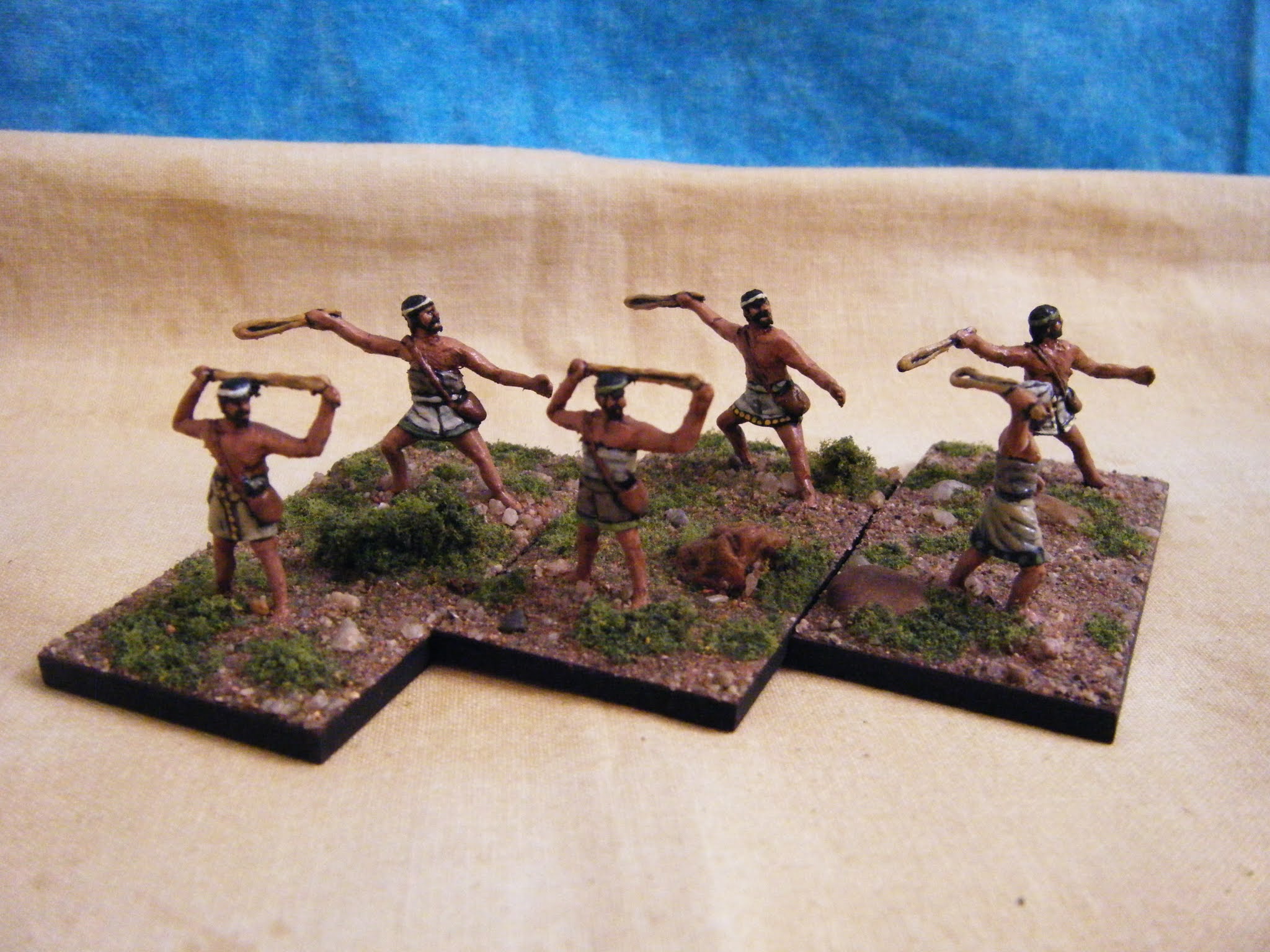
Possibly the toughest units to fill out were the slingers - I needed six (enough for three psiloi units), but the Bedouin set does not actually contain any. I had one spare swordsman who I could convert to be whirling a sling instead of raising his sword. For the rest, I turned to some HaT Punic War Spanish slingers, doing my best to carve their tunics down to bare skin or the chest-wrap thing that the Bedouin figures seemed to have. In the end, they came out a little rough, but I think they'll do fine on the table. (My biggest problem with them is their proportions - I'm pretty sure their arms would go down to their knees if measured out. Possibly they are part orangutan?)
And finally we come to the most controversial element: the camelry! The I/6c Early Aramaean list gets to deploy a single stand of camelry or light camelry. The Caesar set contains a pair of dromedary camels, each with two bow-armed riders. Simple enough, right? Except:
1. The figures in the Caesar set are clearly based on Assyrian wall reliefs that are at least 500 years too late for the period I'm working on.
2. Current archaeological evidence suggests camels had not really been domesticated yet, as of the Late Bronze Age (~1200 BC). To make matters worse, the earliest camels used in Mesopotamia may have been two-humped Bactrian camels rather than one-humped dromedaries.
3. Certain religious organizations are nonetheless insistent that camels must have been present, because Abraham is said to have owned camels, and Gideon from the Book of Judges is said to have faced an army of Midianites and Amalekites, "whose camels were as numberless as the grains of sand.*" (This cleared up something I had been wondering about in the DBA army lists. You may have noted I have not mentioned a I/6b army list - and that's because it represents these Midianites, Amalekites, and early Arabs, with a whopping five units of camelry!)
But despite being anachronistic at best and erroneous at worst, I had the camels and figured I might as well paint them. (And to be honest, it's hard to resist the opportunity to paint animals that aren't horses.) I did swap one of the riders' heads with an infantryman for a little more variety.
And that covers my unexpected fifth DBA army! My plan now is to work on some fantasy figures for a while, but we'll see.
*Judges 7:12