Thursday, October 29, 2020

Orctober in two scales

While casting about for something a little different to paint after finishing up my most recent DBA army, I was reminded that this month is Orctober! As it happens, I did have some orcs in need of painting. In fact - I had orcs in two different sizes! 

First up is a somewhat belated addition to my 20mm Orcish army for Hordes of the Things. It looks like the last time I painted any of these was about eight years ago, but they have seen plenty of action since then - most recently, as it happens, while on loan to my dad. At the time all that was available was Caesar's original set of orcs, but in the years since they have come out with a second set. My dad picked up a box of these a while back, and passed along to me a spare shaman, which spent some time rattling around my bits box. I finally plucked him out of there this month, and found a couple of leftover orcs to provide him a pair of bodyguards. In Hordes of the Things, he should work as a Magician or possibly a Cleric.


The other orcs are more of the Reaper Bones line, in 28mm (though these guys are probably a bit bigger than that, being pretty burly!) Reaper bills them as a Slayer, a Chopper, and a Sniper. I've been working on these much more recently, to be used either for D&D or some sort of fantasy skirmish. With these three, I should now have enough for an entire crew in Ghost Archipelago, should I so choose...


(Incidentally, you may note that my 20mm orcs are green, and my 28mm orcs are gray. Why is this? Well, green skin seemed like a natural enough choice back when I was painting my original 20mm orcs, but in years since I have come down on it a bit - orcs in Warhammer or World of Warcraft might be green, but it's a pretty unusual color for mammals in the real world. When it came time to paint some 28mm orcs, I decided I wanted something different - I wanted a color that was fairly neutral, while also avoiding real-world human skin tones. Hence, gray orcs.)

With these guys out of the way, and Orctober drawing to a close, it will be back to the Bronze Age soon. I have my eye on a sixth army, and I might be able to finish it before this year is out...

Wednesday, October 14, 2020

Bronze Age DBA Part 5 - The Fifth Column

So here I am again, with the fifth of my four planned DBA armies. Yes, that's right, there's some mission creep going on, and it's an exciting tale of head transplants and Biblical controversy! It starts with most of a box of the Caesar Arab Camel Riders and Bedouin I had left over after finishing my Syro-Canaanites. At some point I realized I could just squeeze out a I/6a Early Bedouin or I/6c Early Aramaean army from the remainder and a few other figures I had on hand. These lists represent a variety of early desert nomadic peoples who inhabited the area during the Late Bronze Age, and should be appropriate opponents for my existing armies. 

Both army lists have an option for either a fast auxilia or fast warband general. The Aramaean list has the alternative of a light chariot general instead. The auxilia/warband general was simple enough - these are taken directly from the Caesar Bedouin set, with a standard put together out of bits and pieces. The chariot is one of the trusty Caesar Mitannian Mariyannu chariots. The chariot driver is from the Bedouin set; the archer is the first of our head transplant patients. He's one of the archers from the Mariyannu set, but with his head replaced by one of the archers from the Bedouin set. One of the accompanying chariot runners is another - the man with the shield is from the Caesar Sea Peoples set, but with a replacement sword and a head taken from the Airfix Robin Hood set.

Wb or 3Ax general

LCh general option for I/6c

A second view of the chariot

The core of both armies is mass of fast auxilia armed with javelins: six in the I/6a list, or five in the I/6c list. These are mostly Caesar Bedouin, bulked out with a few Sea Peoples given replacement weapons.

Light infantry as 3Ax

Both lists have a couple of stands of archers - the I/6a list can deploy these either as psiloi or as fast bow; the I/6c list only as psiloi. However, the Bedouin set contained only four archers, and to cover all the options I needed ten! (Not to mention, I had already borrowed one of their heads to give to the man in the chariot - fortunately another Robin Hood figure supplied a replacement.) Scrounging around, I turned up two Hebrews and four Hittite archers in kilts who could blend in well enough.

Archers as Ps or 3Bw

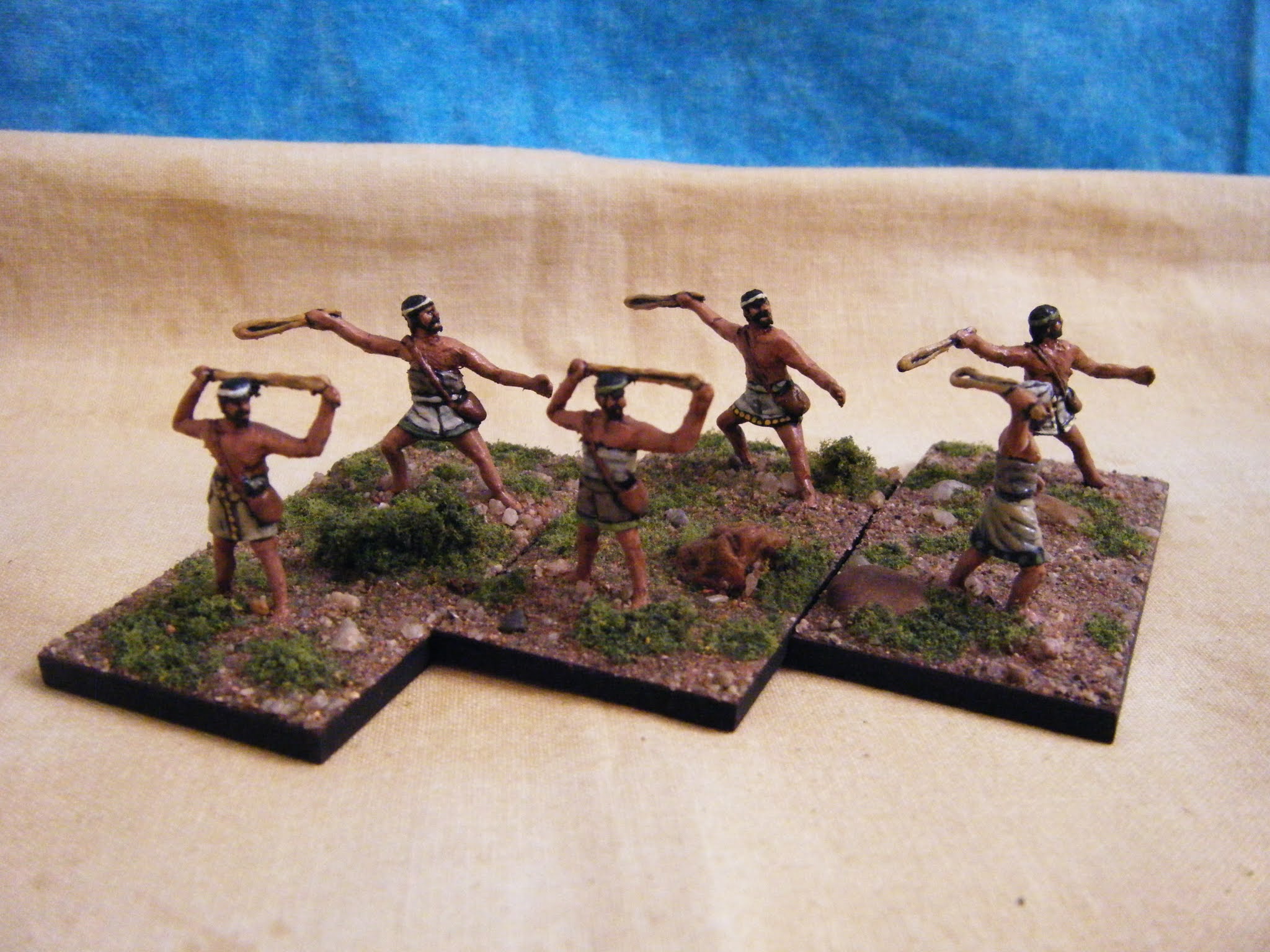
Possibly the toughest units to fill out were the slingers - I needed six (enough for three psiloi units), but the Bedouin set does not actually contain any. I had one spare swordsman who I could convert to be whirling a sling instead of raising his sword. For the rest, I turned to some HaT Punic War Spanish slingers, doing my best to carve their tunics down to bare skin or the chest-wrap thing that the Bedouin figures seemed to have. In the end, they came out a little rough, but I think they'll do fine on the table. (My biggest problem with them is their proportions - I'm pretty sure their arms would go down to their knees if measured out. Possibly they are part orangutan?)

Slingers as Ps

And finally we come to the most controversial element: the camelry! The I/6c Early Aramaean list gets to deploy a single stand of camelry or light camelry. The Caesar set contains a pair of dromedary camels, each with two bow-armed riders. Simple enough, right? Except:

1. The figures in the Caesar set are clearly based on Assyrian wall reliefs that are at least 500 years too late for the period I'm working on.

2. Current archaeological evidence suggests camels had not really been domesticated yet, as of the Late Bronze Age (~1200 BC). To make matters worse, the earliest camels used in Mesopotamia may have been two-humped Bactrian camels rather than one-humped dromedaries.

3. Certain religious organizations are nonetheless insistent that camels must have been present, because Abraham is said to have owned camels, and Gideon from the Book of Judges is said to have faced an army of Midianites and Amalekites, "whose camels were as numberless as the grains of sand.*" (This cleared up something I had been wondering about in the DBA army lists. You may have noted I have not mentioned a I/6b army list - and that's because it represents these Midianites, Amalekites, and early Arabs, with a whopping five units of camelry!)

But despite being anachronistic at best and erroneous at worst, I had the camels and figured I might as well paint them. (And to be honest, it's hard to resist the opportunity to paint animals that aren't horses.) I did swap one of the riders' heads with an infantryman for a little more variety.

Wait a second, who's steering these things?

And that covers my unexpected fifth DBA army! My plan now is to work on some fantasy figures for a while, but we'll see.

A final view of the whole army together.


*Judges 7:12

Tuesday, September 8, 2020

A new toy for an old army

 My Mongol army has been featured on this blog quite a few times over the years - it was one of the first I started building back in 2011 or so, and it has seen plenty of action since, though usually in a fantasy guise. So, when I started leafing through the DBA army lists last year, I was pleased to see that I had already enough Mongols to serve as the core of a IV/35 Mongol Conquest list* - there were just a few units I could add to have all the available options, and one of them was an artillery piece.

Well, my dad happened to have a spare box of Zvezda Siege Machines - Kit 1, and I still had plenty of dismounted Mongols (also of Zvezda manufacture), so I decided it was time to put something together. I liked the look of the ballista better than the catapult, and from the sources I could find it appears the Mongols were happy to use any and all types of artillery, so that's what I went with. The kit was a little more fiddly than my usual fare, but it ended up fitting together pretty neatly.

The ballista, assembled but unpainted.

Painting the ballista, with the crew in progress in the background. I took my best guess at which parts were supposed to be wooden and which were metal. I used thread for the ropes, rather than the plastic bits that came with the kit.

The crew - maybe not the most likely set of poses, but they were what I had available. The guy on the far right is intended to be holding a lance or spear; I gave him a spare ballista bolt instead. His Safety Officer might not approve of how he's carrying it...

The final product, ready to be deployed.

This ended up being a fun change of pace, and I'm curious to see how it will play, whenever my Mongols get a chance to take the field again. (Maybe once I find them some suitably historical opposition.) I have used Artillery in Hordes of the Things before, but my experience with it there has been lackluster to say the least - hopefully it will hold up better in DBA! 

*Turns out, there were actually six DBA armies that my existing Mongols could double for in a pinch: III/11b Central Asian Turkish, III/30b Magyar, III/44 Tribal Mongolian, III/74a Seljuq Turk, IV/35 Mongol Conquest, and IV/67 Jalayirid. Any of these can be deployed as Cavalry general, 2x Cavalry, and 9x Light Horse, which is what I had on hand.

Tuesday, August 25, 2020

Bronze Age DBA Part 4 - Gods and Ends

Alongside my fantasy figures, I've been working on a few miscellaneous items related to the DBA armies I've been building this year. The first of these is a bit of a crossover, actually - it's a Reaper Bones miniature, their Avatar of Sekhmet, but based on a 60mm square base. For DBA, she can be used as a measurement tool to mark a unit's threat zone. For Hordes of the Things, she can be deployed as a God, if the Egyptians are in need of a little divine aid on the battlefield.

Next up are some camp followers for the armies I've completed. These were a fun opportunity to do some little vignettes, representing some of the people that might be tagging along in the wake of one of these armies, and featuring some of the few non-combatants I could put together. (Well, usually non-combatants - DBA does have rules for sending your camp followers out to fight.)

Here are the Egyptians. The waving woman and the man with the bag are included with the Caesar Ancient Egyptian Chariot set. The man with the jar is from the Atlantic Pharaoh's Court set, which someone kindly gifted me at Barrage a couple of years ago.

The Hittites were a little more difficult, since their garb is a little more distinctive. The woman on the left is borrowed from the Caesar Hebrews. The man in the center marching off to battle is part of the Caesar Hittite Chariot set. The woman on the right is actually a HaT figure, from their Gallic Chariot with Warrior Queen set. (This isn't the first time I've put that figure to use - they've shown up on this blog some years ago in a rather different capacity...)

The Syro-Canaanites got a similar group to the Egyptians. The portly fellow in the center is good old Friar Tuck from the Airfix Robin Hood set, done up as a priest, merchant, or other dignitary.

The Sea Peoples were the last ones I had an idea before, and in some ways the trickiest, but also the most fun. Here a couple of raiders are shown making off with someone's fatted calf. (Or maybe they obtained it by legitimate means - who can be sure?) The men are from the Caesar Sea Peoples set, modified to be carrying sticks and ropes instead of swords and shields; the cow is from the Atlantic Stampede set. The most difficult part was tying the tiny lassos...

As I was going through and putting together the camp followers, I realized I had some extra Egyptian archers that were also included in the chariot set. This meant that I could do a few extra units to deploy them as the earlier I/22a list. This has a slightly different mix of infantry than the I/22b list, with additional solid bow units and fast blade units. I am still technically short one bow unit, but they have the option of switching for solid blades, which I have plenty of.


Finally, these are not directly related to the DBA armies, but are a sort of by-product. I previously had some chariots which were mounted on 40x60mm bases, rather than the 60x80 called for by the rules. Due to how these were based, I was able to salvage the original bases and use them for something else - in this case, some plastic spiders that got a quick paint job! These may pop up as Beasts or Lurkers in a Hordes of the Things game some day.


Monday, August 17, 2020

Having a fantastic time

With the pandemic still ongoing, it hasn't been a great year for gaming, but it has been a pretty good year for painting. I find it helpful to have a couple of projects to shift around between - this year, it's been my 20mm Bronze Age DBA armies, and adding to my collection of Reaper Miniatures' Bones range of fantasy figures, for use in D&D or various skirmish games. Here's what I've been up to since finishing off the Sea Peoples:

First up was this warg, which I painted more or less to resemble a gray wolf. This turns out to be somewhat less gray than I expected - or at least, there are some other shades mixed in there as well.

Next was this clerical-looking fellow, who ended up being a bit of a study in shades of brown. I also had some fun trying to paint the bottle at his waist to look like glass.

I went for a much brighter color palette with this "cultist leader" - I also tried my hand at some sort of twisty tattoo design on the side of her head, but I'm not entirely satisfied with how that came out.

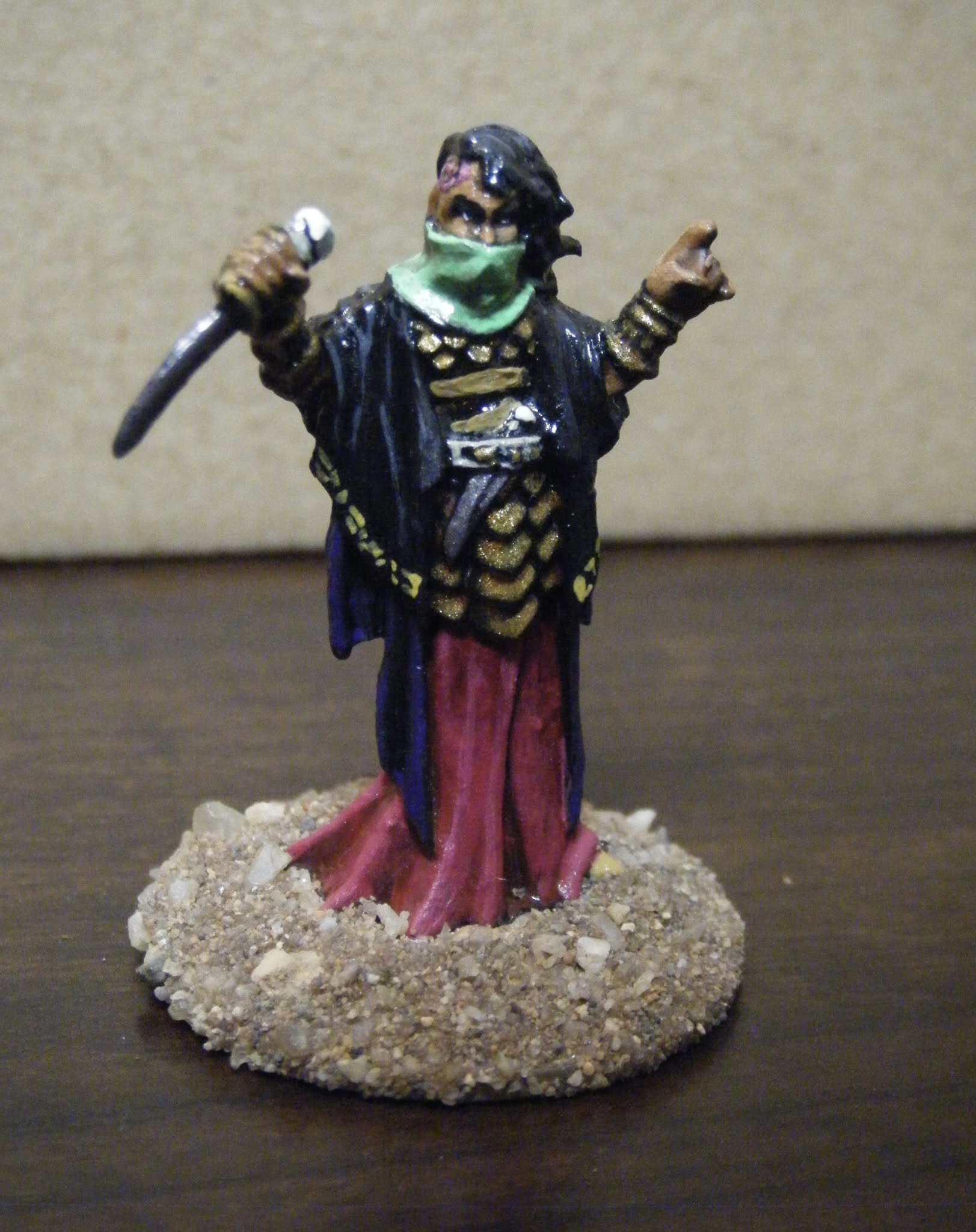
I'd had this rogue or assassin sitting around half-painted for a little while - I had started off trying some object source lighting with her daggers to make it look like they were glowing, but wasn't pleased with how it looked, so I put her aside. Picking her up again, I was able to do a bit more with the effect, and I'm happier with where she ended up. Figuring out how the light should affect the colors of her clothing was interesting.


This flute-playing bard I did in a bit of a rush - at least, I think it's supposed to be a flute. There's also the possibility that she's gnawing on a baguette instead.

I added another three orcs to my growing warband. Unlike the previous batch, these three all required some amount of assembly, gluing various limbs in place before painting.

This gnomish warrior was another quick one - my dad and I decided to have a little speed-painting contest, so this one was done in an hour with a limited palette of paints. I thought the shape of her shield looked kind of like a face in profile, so I took that as a starting point.

On the more formidable side, I painted a pair of yetis. Doing the white fur was an interesting change of pace from the more usual brown or shades of gray; I tried working in some yellow tones in the underlayers, but I'm not sure they really came through in the final results.

And on the less formidable side, I painted half a dozen goblins. I actually painted another set of these guys last year, with pale blue skin, but I decided to change up the colors and do these ones in pale purple instead. (Different tribes? Who knows!) I do have one more set of six around somewhere; maybe they'll get painted green.

Next month it will probably be back to the Bronze Age - I have a few odds and ends to finish up there...

Saturday, July 4, 2020

Bronze Age DBA Part 3 - The Sea Peoples

Back when I started this at the beginning of the year, my intention was to build up a matched set of four DBA armies that were all mutual historical opponents. I started with the Hittites and Egyptians, moved on to the Syro-Canaanites, and now, after a couple of months of work, I am done with the fourth army - the enigmatic I/28 Sea Peoples! As with the others, these are all 20mm plastic figures - in this case, mostly a mix of Caesar Miniatures Sea Peoples and Philistines. (The chariots are a mix-and-match deal - the crew are more Sea Peoples and Philistines, the vehicles themselves are borrowed from the Hittite Chariot set, but the horses are from the Mariyannu Chariot set.)

Historically, these guys are the subject of a number of debates - who were they, where did they come from, and what was their role in the Bronze Age Collapse? Whoever they were, they show up in Egyptian wall paintings, some of which show them as being quite colorfully dressed in reds, blues, and greens. The shield designs are a bit more fanciful - some of them I painted as fairly plain leather or with simple geometric designs, but I threw in a few more representational designs as well.

The army in array

DBA offers three choices of general - a light chariot (LCh), a heavy Chariot (HCh), or solid Blade (4Bd). The blade option features a certain oversized Philistine commander who'd better look out for slingstones...

More solid Blades (4Bd) - lesser chieftains with armored retinues 

The bulk of the army is unarmored "fast" Blades (3Bd) 

Javelin-armed warriors - option of "fast" Auxilia (3Ax) or psiloi (Ps) 


The whole army again - this time from the commander's perspective.

And from the side - I enjoyed letting loose on the shields for these guys. 
 
This army has the advantage that it can also be used pretty easily for the I/29a Early Philistine list - handy if I ever paint up an ancient Hebrew army. For now, though, I'll probably take another break from the Bronze Age to work on some other miniatures projects.

Monday, June 8, 2020

Maps, Part IX

So, in the category of catching up on items long-neglected - I used to post my alternate history map work pretty frequently, but the last time I did so was in... 2013? I'm not as involved with this as I used to be, but I still have a few tucked away from over the past seven years. As a reminder, these are all works of fiction!
_________________________________________________

Mansa Abubakari II of Mali (known as Manden in this world) manages to put his nautical interests to better use by sending expeditions up the coast of Africa instead of sailing off the edge of the world and never coming back. Under his successors, Manden merchants establish further trade links with North Africa, both by sea and across the Sahara. This strengthens the Genoese trading empire relative to OTL, as they happen to be the next link in that chain, but an analogue to the War of Chioggia leaves Genoa as the lesser partner in a Manden-Genoese alliance against the Ottomans and the Castilians. Meanwhile, Manden consolidates its hold over the western Sahel and the small states to its south. As the year 1500 dawns, a certain Genoese explorer has arrived in Niani to petition the Mansa for funds for an expedition to the west, hoping to find a new route to the Orient beyond Ottoman control...
_________________________________________________

"Between the Bay and the Lakes: The Rise of the Susquehannock Confederacy"
From North American Military History Gazette, vol. 32, December 2008

"The rise of the Susquehannocks as a regional power was linked to their acquisition of European firearms, first from the Swedes in their short-lived colony in present-day New Jersey, and later from the Dutch. By taking advantage of this new technology, they were able to subdue their Delaware neighbors and fend off the colonial powers—when Maryland declared war on the Susquehannocks in the 1640’s, they were defeated by the natives and their Swedish allies…

"As the century progressed, the Susquehannocks were pushed into conflict with the Five Nations Confederacy, then the preeminent native power. The Five Nations were likewise equipped with European firearms, acquired through the fur trade. These had allowed them to subdue many of the neighboring tribes and thus expand their hunting grounds—the furs from which could then be traded to fuel further conquests. But crashing beaver populations forced them to venture ever further afield, and brought the Five Nations into conflict with tribes as far away as the Ohio Valley. In 1660, they turned their attention to the Susquehannock.

"The colony of Maryland had watched the Five Nations expansion with alarm, and in 1661 they made an alliance with their former foes the Susquehannocks, hoping that they would provide a buffer against the fierce northern tribes. This policy was a success—a northern invasion was beaten off in 1663, and two of the Five Nations, the Seneca and the Cayuga, were dealt major defeats in 1666. The war dragged on for several years more, as artillery supplied by their Maryland gave the Susquehannocks and edge over the Five Nations. By 1674, the tide had turned, and the Five Nations were clearly on the defensive. Some among the Maryland government suggested negotiating a peace, but others were in favor of continuing the war and ending the Five Nations threat permanently.*

"In the end, after negotiation with the Susquehannock chiefs, the war faction won out—in exchange for exclusive trading rights, the Marylanders would continue their support. In 1680, a peace was finally signed, stripping the Five Nations of their conquests over the previous decades. Indeed, they would be five nations no more—the remnants of the Seneca, Cayuga, and many of the Onondaga would be incorporated into a new Susquehannock Confederacy. The remaining nations would become clients of the French, who called them the Iroquois…

"Many of of the Five Nations’ former tributaries transferred their loyalty to the Susquehannocks as well, and so by 1680, the Susquehannock Confederacy stretched from the shores of the Chesapeake Bay to the Great Lakes…"

*This is the POD: in our timeline, Maryland made peace, and in fact turned on their former allies, massacring their leadership…


_________________________________________________

Three and a half billion years in the future, a matrioshka brain is running a simulation of the rise of one of its creator species, when a minor error causes a hyperspherical cross-section of the simulated world to be temporally transposed by 2^10 cycles...

2017. At first they thought it was a summer thunderstorm. The first thing everyone noticed was a great booming sound, like a clap of thunder but larger, as two masses of air at different temperatures and pressures were suddenly brought in contact with each other. Those who were outdoors could see a strange roiling in the sky, as clouds formed, joined, or dissipated. One or two people near the boundaries of the sphere saw features seem to vanish in an instant - trees, roads, telephone wires. Later, they were able to trace the boundaries of "The Zone" by finding objects which had been bisected by the transposition. Staff and campers at Box Canyon Ranch noticed as the power went out. But it was several days before anyone grasped the truth - that their little circle of northern New Mexico had been thrown back in time.

Once this hypothesis had been reached, a party from Box Canyon Ranch set out within a few days, following the Chama River down to the Rio Grande, then heading up into the hills where Santa Fe should be, to determine if it might be possible to make contact with American or even Spanish colonial authorities. They found nothing. A second party set out a few days later, headed west...

993. The strangers had come down from the high country to the east, Qoyanomtiwa's scouts had reported, though they did not dress like easterners. They were oddly pale, and most curious of all, some were being carried by elk without horns. No one seemed to have guided them, but somehow they had found their way to the Great House. Qoyanomtiwa pondered this, and at last he shrugged. "Let us go and meet these strangers," he said. "Maybe they are Pahana, maybe not. We shall put them to the test, and if they fail, we shall treat with them as with any other men or women."

2017. "It's not much like how I remember it," Rick said. "It's bigger, but smaller at the same time." It didn't even look much like the reconstruction in the National Geographic they'd found in the library--most of Chaco Canyon didn't seem to have been built yet. But there was Pueblo Bonito, sure enough, and not just the ruins Rick had visited last fall - the stone walls stood several stories high, and right now they seemed to be bustling with people.

"Look," said Carla. "Someone's coming out." Indeed, a group of several people was emerging from a doorway, though only one seemed to be carrying a weapon.

"Alright, let's not get any closer. Wait here for them."

993. Qoyanomtiwa surveyed the strangers. There were five of them, but the scouts were correct - each of them seemed to be seated on an elk of some sort. As he watched, the strangers climbed down off these elk, and stood. They did not seem to be carrying spears or other weapons that he could see, though who knew what powers they might have if they could command these beasts?

"Lomankwa, tell them to come no closer," he said to the shaman.

2017. Rick watched as one of the delegation drew out a small pouch of white powder, and sprinkled it in a line on the ground. "Let's leave the gifts here and back off a bit," he said, watching the shaman's gestures. Carla nodded, deposited the "gift package" they'd assembled at the Ranch, and stepped back a few paces.

993. "I think they might be offering a trade," said Macatoiniwa. "Remember the men from the south, five years ago, who brought the green birds and the shells?"

"Yes, I remember," Qoyanomtiwa replied. "In that case, let's see what they have to offer." They advanced to where the strangers had laid their bundle. A square of fine red cloth, wide as his arm, lay on the ground. On it were knives that glinted like the sun on water, plates and dishes with strange intricate designs, several garments of white cloth, jewelry of silver and turquoise, and a pile of shining disks the size of his hand. "These seem like fine goods," he said to Macatoiniwa. "Let's see if we can come to an arrangement..."

By the time the error was noticed, milliseconds later, several dozen processing cycles had passed. A new hybrid culture was blossoming across the affected area, as the ancestral Puebloans adopted and assimilated these strange newcomers. The area had already been headed for an era of rapid growth and development due to favorable climate conditions, but the new crops and livestock seemed likely to extend it further and faster. Already, trade networks were forming, east to the Mississippi Valley and south into Mexico.

A quorum was called to determine whether to end the counterfactual scenario or to let it continue...

_________________________________________________

Snipped from a copy of The Economist in a nearby timeline:


_________________________________________________

Paratemporal Institute Report

Despite Dr. Saunders' initial reaction, we do not believe that Artifact QM-176002a indicates an alternate geography on timeline Aleph-8644. Further evidence suggests that this timeline featured an Anglo-Saxon kingdom or state surviving into the 17th century or beyond, and taking part in an equivalent to the Age of Exploration. It is probable that the cartographer attempted to collate reports from multiple expeditions, suggested by the variety of dates given at points around the map. The inaccuracies most likely result from imperfect or incomplete information.

_________________________________________________

_________________________________________________

BACKGROUND

The Ann Arbor Anomaly is best described a portal leading to central North America during the early Cenomanian Age of the Cretaceous, approximately 100 million years ago. The portal is perfectly circular, usually around four feet in diameter, and is only visible and accessible from one side. The size of the portal fluctuates; when first observed it was only a few inches across, then expanded to approximately its present size over the course of three days. Since then it has varied between three and six feet in diameter, with no discernable pattern to the changes.

DISCOVERY

As the name suggests, the Anomaly is located in Ann Arbor, Michigan, where it seems to have appeared in a park on the night of November 12, 2019. It was discovered the next morning by Aidan McKinney, who was walking his dog in the park when he noticed a plume of vapor condensing out of what seemed to be a small hole in the air. Mr. McKinney notified some friends of his, who briefly ventured through to the other side. There they found a humid jungle environment with unfamiliar fauna, including some unmistakable dinosaurs. The group attempted to notify the authorities, but were initially disregarded until photographic and video evidence was provided and independent confirmation from other sources was received. A variety of experts from the nearby University of Michigan then took over the scene until federal authorities arrived to secure the anomaly.

EXPLORATION

In the two years since the appearance of the Anomaly, a number of expeditions have gone through to the far side, and a substantial facility has grown up on both sides of the portal. The main bottleneck has been the limited size of the portal, making it difficult to transport large equipment. Outside the facility on the far side, there are four zones:

Zone 1 is the immediate area around the anomaly, which has been thoroughly explored and mapped. Most of this zone is a humid rainforest, part of the drainage basin of the Cope River, which runs west to the Mowry Sea.

Zone 2 stretches about as far as the shores of the Atlantic and the Mowry. Most of this has been mapped by solar-powered drones, so major land features are known. Some manned expeditions have taken place, mostly cataloging the flora and fauna.

Zone 3 has been cursorily explored by the newest long-range drones, mostly mapping the shorelines as part of the effort to date the far side by comparing landmasses to geologic data.

Zone 4 is anything not yet surveyed; landforms in this region are based on geological conjecture only.

SCIENTIFIC CONTROVERSIES

The cause of the anomaly is unknown. A popular theory is that the anomaly was somehow caused by the GLC particle accelerator in Japan, which had gone into operation only a few days previously. However, so far there is no evidence to support this, and activity at the GLC does not seem to correlate with observable behavior of the portal. The portal emits a unique radiation signature when contracting or expanding; based on this signature, physicists have detected two other possible anomalies (one in New Mexico and one in California), but both have been microscopic in scale and lasted only a few seconds.

There is also an ongoing debate over whether the far side is our direct past, or some type of alternate timeline. Efforts to plant an object on the far side that could be retrieved in the present have so far been unsuccessful.

The exact date on the far side is still being narrowed down based on astronomical and geological data. The current estimate, based on some new bathymetric survey data from the Mowry Sea, is 99.7 ± 0.3 million years before present.


_________________________________________________

In the late sixth century, invading Angles had carved out two kingdoms along the coast of northern Britain - Bernicia in the north and Deira in the south. Around 593, a man named Æthelfrith became king of Bernicia, and began pushing inland more vigorously, particularly against the Brythonic kingdoms of Rheged and Gododdin. In 599, he married a daughter of king Ælla of Deira, sealing an alliance between the two Anglian kingdoms. In response, Mynyddog of Gododdin began building an alliance among the fractious Brythonic kingdoms, gathering warriors from among them and eventually launching a preemptive strike against Æthelfrith at Catraeth in 600. In our world, this effort failed, and Æthelfrith would go on to smash the Britons and take direct control of Deira. The combined kingdom would eventually come to be known as Northumbria.

In this world, things go a little differently - Æthelfrith is killed at Catraeth, and the Anglian alliance falls apart. There is infighting among the Bernicians, and the Britons are able to regain much of the lost territory, while Deira takes over some of the south. The prestige of the victory allows Gododdin to become the paramount kingdom among the northern Britons under Mynyddog and his successors. Now, twenty years after Æthelfrith's death, the Britons face two threats - Edwin of Deira, who has ties to the southern kingdom of Mercia, and wily old Áedán mac Gabráin, of the Gaelic kingdom of Dalriada, who has lately made common cause with the Pictish tribes of the north.