Sunday, May 6, 2012

Huzzah! 2012

This past weekend Dad, William, and I made our way up to Portland for Huzzah!, the convention of the Maine Historical Wargamers' Association, where we met up with Ross MacFarlane, of Battle Game of the Month. Quite a drive for us, living in Maryland, but an excellent convention, with lots of great games to see and to play in.

We left Thursday morning, a few hours later than we'd hoped, and got into Portland about 8:00 or 9:00 p.m. that night. The hotel where the convention was held was conveniently located just off the highway, though we still managed to miss a turn on our first attempt to find the place. Upon arriving we found that each guest was given a complementary Whoopie Pie, which definitely is a plus in my book. (For anyone who doesn't know what a Whoopie Pie is, it's a sort of soft round sandwichy chocolate thing filled with fluffy marshmallow stuff, and is nothing at all like a Whoopie Cushion.)

Games were not scheduled to start until Friday evening, so the first part of the day was set aside for some extracurricular gaming and sightseeing. (Actually, sights were a little hard to see given that it was raining, but we did go down to the waterfront and feed William his first lobster.) The first game we set up was a trial of the popular Basic Impetus rules, with figures pulled together from Dad's selection of 6mm armies which we'd brought along. Ross was familiar with the rules already, so after a quick briefing on the mechanics, he and William led an army of late Imperial Romans up against a force of 'Visigoths' (actually Franks, but at 6mm scale who can tell?) led by Dad and myself. We were favorably impressed by the game, and the Visigothic victory was a very near-run thing; one of our double-sized warbands managed to fend off two flank attacks from their heavy cavalry to pull off a win.

Before the game, trying to scrape together two matching Impetus-sized armies.

Sometime in the first few turns. The Romans got to set up second, which seemed like a pretty big advantage--we probably shouldn't have left our cavalry unsupported on the left like that, as they were able to concentrate on them first.

Near the end of the game--our masses of infantry threaten to overwhelm the second Roman legion.

William and his crustacean.

After lunch, we came back to the hotel and set up another pick-up game, this time a playtest of the Renaissance game that Dad and Ross would be running on Saturday. William and I took the English, who were trying to retrieve one of their large guns that had gotten bogged down. Unfortunately, while we were mostly able to hold off their cavalry on the wings, the French pike block reached the center before we could get the gun dragged away, and we really didn't have enough troops left to chase them off.

The cause of all the trouble.

The French commander, considering his options.

Me, possibly wondering what William's up to on the left flank.

The English general.

We got the limber to the gun...

But it wasn't enough.

After a quick dinner at Panera Bread across the street, we came back for the first round of official games. William and I had signed up for a what-if scenario featuring a 17th century Anglo-Dutch conflict in the wilds of New England, using one of the versions of the Gaslight rules, which we're pretty familiar with. The Dutch forces were entering over the bridge on the left end of the table; one English player had a force of cavalry and musketeers positioned on a hill overlooking the bridge, while William and I as the other English players marched up the road to his aid. As it turned out, we needn't have bothered--the other English player sent his cavalry charging straight into the Dutch column the first turn, starting a melee that lasted much of the game and kept the Dutch thoroughly occupied. (I think there may have been an issue with how morale was being done, but the Dutch players were rolling very poorly, so I'm not sure how much it really mattered...) Some of their native allies sniped at us from the woods for a while, but I'm pretty sure I neither suffered nor inflicted a casualty all game. Still, it was a very neat set-up--I wish I'd taken a picture or two of the Indians, who were very well painted, and William and I spent some of the time tossing around the idea of doing a similar game, possibly based on one of the odd little episodes of Maryland history--the Battle of the Severn.

The bridge kerfluffle.

Marching down the road. Unfriendly Natives are visible along the treeline.

Investigating a dead body that had been left in the road.

The next morning, moving forward in history I ended up in the Battle of Brandywine, as the American commander, with Ross on my right (possibly lured in by the 40mm figures) and a rather enthusiastic child on my left. The rules seemed to be based on the Battle Cry/Memoir '44 family of board games, with which I am somewhat familiar, and which made it a bit easier to pick up. I spent much of the game keeping an eye on the situation to the left--the kid was in a tough position, trying to hold off a strong force of British and Hessian regulars with a force that contained a lot of weaker militia units, but he managed to do pretty well. On the right, the British had executed some sort of flanking maneuver--I wasn't paying as close attention to the action, but it seems they were hindered by Ross's sharpshooters, who potted the British commander on that flank. In the center, I was able to spend much of the game sitting on a hill and exchanging artillery fire with William, but I did have to fight off an assault from his troops at one point. This game also went down to the wire, but we squeaked it out--the kid managed to hold off another charge and destroy the attackers to get the last victory point.

Sometime near the middle of the game--William is charging up the hill against me; the British are pressing forward against our left.

Saturday afternoon, I played in a Boxer Rebellion game, leading part of a naval landing force sent to capture a Chinese arsenal. The scenery on this one was great, and the rules were simple and bloody. While we came pretty close to achieving our objective, and even managed to hold the arsenal for a few turns, in the end the Chinese cannons really wore us down, and the handful of survivors had to make their way back to the ships.

A couple of fellows make a quick stop on the way up to the arsenal.

The only survivor from his unit, he spent the rest of the game training with an old kung fu master to one day take revenge against the foreign devils.

Preparing to go over the wall.

The last game I played in was a Punic War naval battle on Saturday night. This was very interesting, as while I'm sort of aware of the basics of galley combat, I don't think I've ever played a game of it before. The scenario involved the Carthaginians trying to get a merchant convoy past a Roman blockade.Both sides ended up basically splitting their forces into two groups--a larger one and a smaller one. I was on the Roman side, commanding the smaller force--two squadrons of quinquiremes, relatively heavier ships, and I ended up facing off against the larger half of the Carthaginian fleet--two squadrons of quinquiremes supported by two more squadrons of the lighter triremes. I knew that my ships would be at the advantage in boarding actions, but I wasn't really able to set many of these up--my bigger, slower ships kept getting rammed by the fast Carthaginian triremes with their veteran crews. (Turns out I'm really bad at noticing when I'm about to be rammed and reacting accordingly.) Still, my first squadron managed to break through their line and make for the merchant ships--and we had just managed to grapple one when we had to call the game. Luckily, the other part of the battle had gone much better for the Roman side, as the Carthaginians had gotten penned in between some smaller islands and the main coast and the main body of our fleet was positioned to wreak havoc on them. So over all it was a victory, as we prevented the convoy from reaching the city. All in all, a very interesting game, though I may look into something with a few less tables if I ever want to do something similar.

Nice, neat Roman lines at the start of the game.

My part of the action towards the end. When you can't see your ship under piles of chits marked "Fouled" or "Grappled" or "Crippled," you may be in trouble...

Overall, Huzzah! was a great experience; I'd definitely do it again if the opportunity presented itself. I got the chance to play in lots of great games, and the whole thing seemed very smoothly run. Just to wrap up, here's a few more pictures, including ones of games I didn't play in...
Ross's Aroostock War game on Friday evening.

A magnificent Peking setup.

'Rough Wooing' Saturday afternoon.

The official sponsor of Huzzah!, apparently.

Sunday, April 29, 2012

Saxons vs. Vikings

A couple of my brother's friends came over for a game today, so Dad decided to haul out his old multiply-based Dark Ages armies and try them on a little Warhammer Ancient Battles action. (Somewhat tweaked to account for the basing and whatnot.) William and I took the defending Saxons, while our guests took the marauding Vikings. We set up position with a small village to our right, and a pair of low hills between the opposing armies.

The Saxon Eorl prepares for battle.

Little does this shepherd realize that his peaceful pastures will soon be soaked in blood!

The first few turns were fairly uneventful, as both armies advanced towards each other. The Vikings took up positions on a pair of small hills, much to our chagrin, as we figured the high ground would make them difficult to push back.

Vikings on a hill. Saxon huscarls moving up on the left, thegns to their right.

The next couple turns saw the armies meet and clash--a group of lighter Viking bondir dashed out from the Viking lines to attack my elite huscarls, while William's thegns, to my right, overcame their fear of the Vikings, broke their shieldwall and charged impetuously up the hill towards the waiting foe.

"Ut! Ut! Ut!" 

Despite the odds, the thegns managed not to lose that combat. Meanwhile, the Vikings did not fare well against my huscarls. In fact, they broke and ran... inciting panic in much of the Viking center. Including the troops on the hill, despite the presence of the Viking chief, who was promptly dubbed "Ragnar Brown-breeks."

"Wait, come back! We haven't finished stabbing you yet!"

It took two turns for their leader to stem the rout, and by that point a number of the lesser troops had fled the field and we had gained a good deal of ground on the right flank. On the left flank, however, things weren't going so well--a group of my scruffy fyrdsmen had routed after attempting a similar charge up the hill, and were overrun by pursuing Vikings. My better-equipped thegns were similarly repulsed, and narrowly escaped being run down themselves, despite the presence of the Eorl himself.

Vikings in hot pursuit of my thegns.

Fortunately we were able to turn and rally before the Vikings slammed into us, and a protracted melee developed. Our long spears, deployed in depth, were beginning to give us the advantage, when events on the other flank intervened.

Melee on the left. The Vikings on the right have stemmed the rout, and are facing our thegns and huscarls again.

A large group of fyrdsmen had been making their way through the village off to the right, despite some opposition from a band of bow-armed Vikings. It was about at this point that they finally emerged from among the huts and hedges, uncomfortably close to Ragnar Brown-breeks' left flank. Finding himself rather outnumbered, Ragnar decided to break the standoff that had been developing over the past few turns, and to charge our shieldwall of thegns and huscarls. This didn't work out too well, and his troops fled the field. Although the other Viking commander still had most of his forces intact, at this point it was decided that Saxon arms had carried the day, so we packed it in.

Field at the end of the battle--there's a Viking column coming up the center that didn't quite make it to the scene of action in time.

Overall, it seemed like a pretty good game--though we did get a lucky break early on, for a while it looked as though things were going to swing back the other way. And while we glossed over some aspects of the rules, it was good to brush up on the basic WAB mechanics again.

And next, off to Maine, where we will join forces with the redoubtable Ross Macfarlane for Huzzah! (Well, technically we leave Thursday, but I don't anticipate much happening in the miniatures line over the next few days...)

Saturday, April 28, 2012

More of the same

Leaving aside the world of LEGOs for the time being, I've continued working on my Bronze Age stuff.

First up: a standard-bearer in a chariot:


That'll fill out my Mitanni chariot corps for the time being, though I still have some Assyrian chariots to do as well as maybe one or two others. (I've got several boxes of Hittite chariots sitting around unassembled; I've been considering painting up a few, given how much my painting technique has evolved since I did the first ones about five years ago.)

Next up, another stand of Sea Peoples. This'll be the last of them, for now--six stands will probably be sufficient for my Historicon scenario, counting my four and Dad's two. Also, four stands is about all I can squeeze out of one of Caesar's boxes, though I have a few spares left over--I have a couple ideas as to what I'll do with those...


And, speaking of the Historicon scenario, I've been adding to my baggage train. Here we have a second pack donkey, four porters carrying bags, (from the Egyptian Chariot set) and a stand of cattle selected from the Atlantic Stampede set. Together with what I already have, this should give me enough baggage for now. (Unless I come up with a neat idea before July...)


I probably won't have much time to paint for about a week or so--we've got a game planned for tomorrow, then I have some non-miniatures stuff to take care of before we head off to Huzzah next weekend! So expect a report on that at some point...

Saturday, April 21, 2012

Hordes of the LEGOs

And now, as they say, for something completely different! Or rather, a couple of completely different things. My brother has spent the past few weeks digging around in our LEGO collection in preparation for his own Historicon game, but the other day he and I sat down and pieced together a couple of pseudo-medieval armies for Hordes of the Things. This afternoon, we had an opportunity to sit down and play a few games with them, which was mildly amusing--unfortunately, the selection of figures available to us did not allow for a whole lot of variation between the armies, but here's what we came up with:

The Army of King Leo (Red)

1x Knight General
1x Knights
2x Riders
1x Paladin
2x Shooters
4x Spears

The Army of Count Falco (Blue)

1x Knight General
1x Knights
1x Magician
2x Shooters
2x Blades
4x Spears


Before game 1

I took the blue side, William took the red. The first two games went pretty quickly--first game, my general got cut off and surrounded; second game, his general charged into my archers and was unceremoniously shot out of the saddle. The third game went a bit longer, and saw me finally get a chance to apply my infantry advantage, as my blades cut through his spears. Our shooters scuffled around in the one patch of woods for a while to no effect, while he attempted to outflank me with his riders and paladin. Unfortunately for him, my knight general was able to best his paladin this time, and so Count Falco claimed victory.

A couple of turns into game 3.


Infantry meet on the hill.

The blades break through.

End of the game. William's infantry is gone, and his flanking maneuver has failed.

After we cleared all the LEGOs off the table, Dad and I set up a different game--a little fantasy skirmish with A Song Of Blades And Heroes. My previous experience with this rules system was not particularly encouraging, but it worked somewhat better this time around. I still don't care for the activation system, and I think the game's notions of troop "quality" are a little counterintuitive, but at least it plays fast. My humans eventually chased off Dad's orcs, though not without a few casualties, including their leader. (Apparently he wasn't that good in combat--I guess that's to be expected when you don't wear your helmet and stand around gesturing at things in a commanding manner rather than actually picking up a weapon...)

Shortly after the first orcs appeared. My ill-fated leader is one of the fellows standing behind the wall.

End of the game. The two men by the building have just dispatched the last orc--two managed to escape off the table.

Dad was taking some pictures during the game, so there may be more pictures up on his blog at some point...


Tuesday, April 17, 2012

Asses & Assyrians

Now that I've signed up to run a pair of Bronze Age games at Historicon this summer, I've been focusing on getting more figures done for that particular project--there's a number of things I would like to get done before then, and only a couple of months to do them.

First up, my eighth and probably final (at least for now) block of Hittite spears. I have plenty of these guys already, I've painted pretty much all the ones I own, and I don't think I'll need any additional ones for the scenario I have in mind.


Next up, the first fruits of my brainstorm from a few weeks ago. This is intended as an Assyrian chariot from the period stretching from the Assyrian Old Kingdom to the end of the bronze age, suitable as vassals of the Mitanni kingdom or a power in their own right. Its historicity is somewhat suspect, as I basically just swapped out some horses and stuck some of Caesar's Assyrian Chariot crew (who are from an era several centuries later) in one of their familiar Mitanni chariots, but it looks different, and that's what counts for me here.


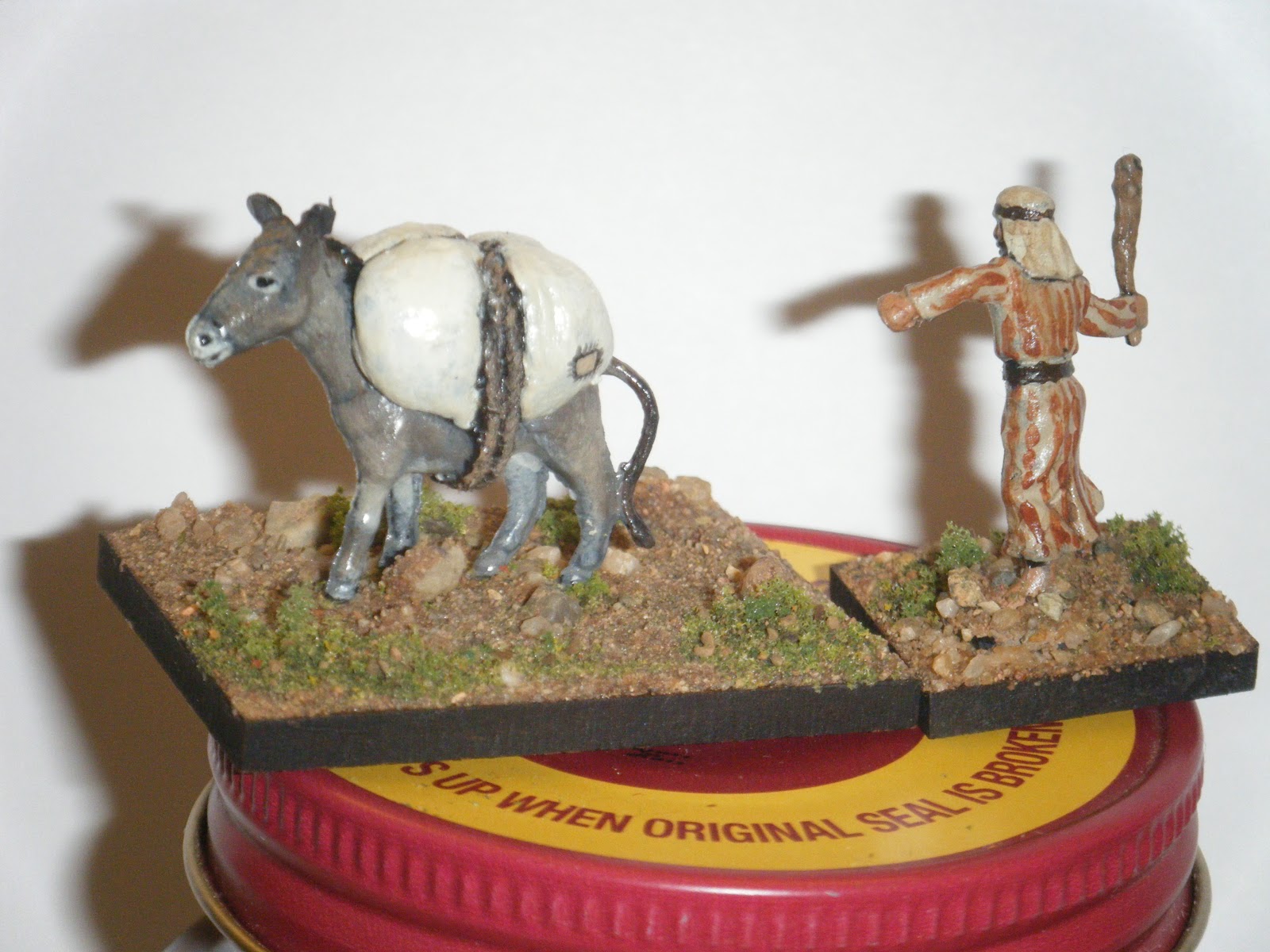
One thing that I will need for my game is a baggage train--I have some cows and an oxcart already, and I wanted to add a few more elements to that. So here's a pack donkey who has been sitting in my box unpainted for some time. He actually started life as a zebra from a Tarzan set, but a blob of modeling putty and some florist's wire has given him a new purpose in life. (I have another one sitting in a box somewhere that I haven't got around to loading up yet.) The fellow along with him is one of Caesar's Hebrews, who I painted up a while back as one of a few random civilian types.


Lastly, here we have another stand of the ferocious Sea Peoples. I finally got to the craft store this weekend to pick up a few new brushes, which has made the detail work on these guys considerably easier. Their active poses make them a little difficult to fit eight to a base, but I managed.


In the pipeline now are some additional cows, one more stand of Sea Peoples infantry, and more chariots (of course), including a standard-bearer for the Mitanni, the rest of my Assyrian contingent, and a leader for the Sea Peoples. After that... we'll see. I have my eye on some Arabians, but I really just want the scruffy infantry; I don't have much use for those camels...

Monday, April 9, 2012

Maps, part V

The same caveats hold here as with I-IV.  These maps are fictional, do not depict real history, and should not be used as resources, nor are they intended as a political statement about the inhabitants of any given piece of land, now or at any time in our past.


First up, a couple more maps of an alternate West Africa--actually the same setting as the last map in part IV. I had some fun playing around with somewhat different techniques on these:


Next up is actually a future history map, rather than alternate history, showing settlements on Mars. A few of the ideas here are actually ones I've had floating around for a couple of years; I was idly considering using them in the background of a roleplaying game at some point, but never got around to it.
Two centuries in the future, the Solar System is slowly being colonized as advances in superconductors allow ships to "sail" between planets, borne on the charged particles of the solar wind. Humanity has once again entered an age of exploration and colonization, and the great powers of Earth--national, supranational and corporate alike--strive to lay claim to the resources now within their reach.

Mars remains an uninviting place, despite the terraforming plans being laid out by the Long Run Foundation, but many of the great powers have planted a few token colonies--many of them having grown up around early scientific bases or research stations, others exploiting the planet's mineral resources. For some smaller groups, Mars offers  the chance to build a new society away from the prying eyes and laws of Earth. Many of these stake out claims in the "International Territory" or cut deals with the major powers--or simply squat on others' turf, gambling that no one will care enough to evict them.

But a few have come to the Red Planet against their will. Several decades ago, the European regime saw an opportunity to finally deal with some of their troublesome minorities--and so thousands of Basques and other "undesirable subnationals" were given the choice between increasing persecution on Earth or freedom on Mars. Those who chose Mars have done their best to forge a new nation for themselves, and recently have thrown off the yoke of the "Martian Resettlement Supervisory Council," proclaiming themselves the "Basque Republic of Mars."


The last one of this batch was inspired by reading up on the Samaritans, who still exist today as a tiny minority in the Levant. What if things had gone more favorably for them?
Cyrus the Great decides not to release the Jewish people from their Babylonian exile, and only a few end up returning to the land of Judah. Instead, over time the religious composition of the Levant shifts towards the Samaritans, a Hebrew-speaking ethnoreligious group descended from the northern kingdom of Israel, with their own version of the Torah and their own holy site of Mount Gerizim.

The Achaemenid Empire dominated the Near East for several centuries, and at times exerted some measure of control over the Greek mainland. As a result, Magna Graecia saw a bit more immigration, and a Greek-speaking polity in Sicily was for several centuries the major rival of the rising Roman Republic for control of the Western Mediterranean before being overcome.

The Roman Republic of this world had little in common with that of ours, being in some ways both more and less Hellenized, but over time it acquired significant eastern territories from a variety of Achaemenid successors, including a largely Samaritan "Kingdom of Israel." The Samaritans got along somewhat better with their new overlords than the Jews did with the OTL Romans, and were not scattered across the Empire. Neither do they spawn any sort of spin-off interested in converting large numbers of Gentiles; Samaritanism remains strongly linked to its homeland and its holy places.

Fast-forward a couple of millennia. Rome is long since fallen, though its influence remains in many nations of the Mediterranean, even those overrun by Celts, Germans, and various nomadic peoples. The Near East was, for a long time, split between an Egypt-based Roman successor, and a resurgent Persia, with Israel usually falling under the sway of the former. But in recent centuries, the diverse states of western Europe have been experiencing a scientific and industrial revolution, while the empires of the Near East have fallen behind. Persia has retreated into a state of semi-isolation, while the last dynasty of Egypt has been overthrown: without them, the lands of the Levant have been splitting apart along ancient ethnic and religious faultlines, and a Samaritan state of Israel has emerged once more.

And in the unremarkable provincial town of Yerushalem dwell the last members of an obscure and dwindling sect known as "Ezraic Samaritans," or "Yehudim," of interest only to a few ethnologists...

And that's it for now! Time to go paint some chariots...