Friday, July 15, 2011

Fun with technicals

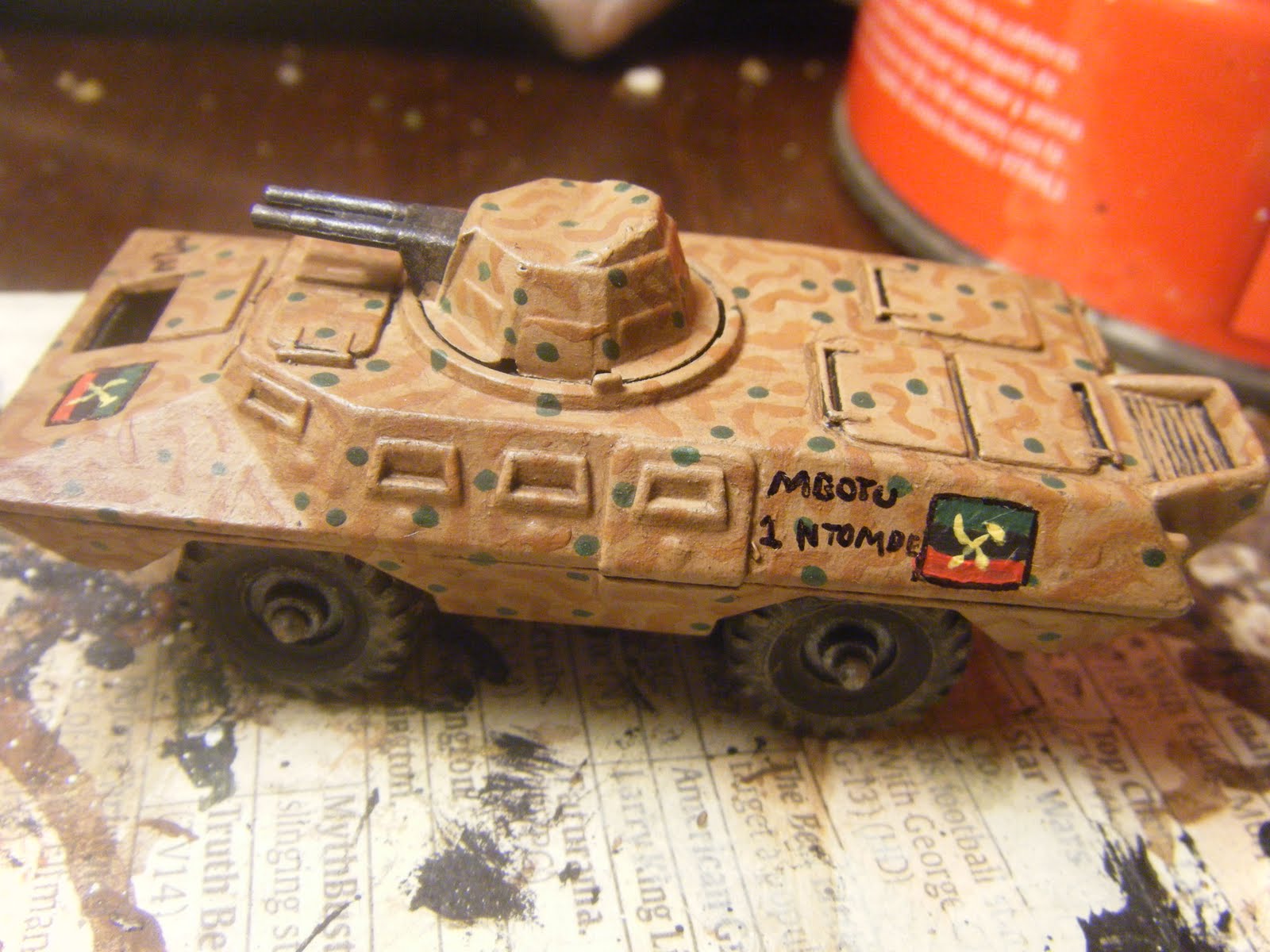
One of the reasons I am so enthused about this modern Africa project is the prospect of constructing technicals. Having completed my first regular unit for the Mbotese Army, I decided that I would do up a militia unit next. That means it's... Technical Time!

(Alright, the pictures should make it clear, but for anyone not in the know: a technical is a vehicle, usually something like a pickup truck, that has been modified to carry some sort of weaponry--machine guns, anti-tank weapons, or whatever else you can buy, beg, borrow, or steal.)

Here's some shots of my early mock-up, before painting. The figures are Caesar "Urban Resisters," the truck is from God-only-knows. It says "Made in China" on the bottom, and it's seem some rough use. Perfect technical fodder...


And here's the mostly-finished product. (May do some touch-up stuff on the base before I give it the final spray coat.)


Wednesday, July 13, 2011

The People's Republic of Mbotu

After a brutal and protracted guerilla war, the Marxist Succession Alliance has overthrown the colonial government of the tiny Central African country of Transequatoria, and proclaimed itself the People's Republic of Mbotu. A new flag flies over the capital of Ntomde: green for the north, black for the south, red for the workers and peasants!

But forces both internal and external threaten the stability of Mbotu. The Muslim tribesmen of the north were willing to help the MSA throw out the Transequatorians, but now tensions are on the rise between the tribes and the new government in Ntomde. And a group known only as the "Chosen Intervention Phalanx" has been staging incidents on the border with neighboring Zoote. Surely these provocations cannot be allowed to go unpunished!

When it comes to wargaming, I tend to prefer imaginary countries to real ones, so when I first ran across the rules for AK47 Republic, with its randomly generated flags, countries, and faction names, I was intrigued. Years ago, my father put together a generic modern game, with Matchbox vehicles and 20mm plastic troops, but using a different set of rules. As a matter of fact, those figures got hauled out for a game fairly recently--although they're getting kind of shabby these days. (Hadn't figured out techniques for painting soft plastics yet.) At times I've considered adding troops to that project, but never got very far.

But it wasn't until this past weekend that I finally decided to start working on an actual AK47 army of my own--as I mentioned in my last post, I picked up a couple of boxes of figures and some random vehicles at Historicon. I've been supplementing these with a few random figures dredged up from my childhood, mostly guys who I've identified as Esci Spetsnaz, and some vehicles. 

I also knocked together a building; I've seen the "corrugated cardboard roof" described in a couple of places, and it turns out it's not that hard to do. Unfortunately I must have misjudged the size a bit, as the roof is missing just a little overhang on the ends.


Sunday, July 10, 2011

Historicon 2011

In many past years, the arrival of the renowned Ross Macfarlane at our house has marked the beginning of several days of frantic terrain building, as we scrambled to complete the scenery for a convention game. However, for once we were prepared; the fortress had been finished on schedule, so we had the chance to run a playtest game before Historicon to see how the siege rules would work before releasing them on the unsuspecting public.

As it happened, for the purposes of the playtest I was tasked with attacking the fortress, and I must admit I rather made a botch of it. I managed to lose an entire battery of siege guns to a well-timed sortie from the fortress, and it took me several weeks of in-game digging before I could position my remaining cannons to breach the walls--and after all the waiting, I threw my final assault in too soon, and was bloodily repulsed!
Top: My trenches approach the wall.
Bottom: Assaulting the wall. Note that my own troops (in the orange coats) are actually on the opposing side here...)

Thursday morning we packed the fortress and all of our trenches and batteries into a couple of medium-large boxes and set out for Historicon, held this year at the Valley Forge Convention Center up in Pennsylvania. We had five games to run over the course of the convention; three of them siege games. The first game, however, was a more open battle beneath the walls of the fortress, as a train of supply wagons attempted to reach the gate without being caught by the enemy. In the end, they were halfway successful--three of the wagons made it to safety, but the others were overrun by a last-minute charge from some Rosish light infantry...


Top: Wachovian infantry fan out to protect the convoy.
Center: Hussars move forward. In the background, Wachovians trade fire with the white-coated Stanzbach-Anwatsch infantry.
Bottom: Schoeffen-Buschhagen dragoons sally forth from the ravelin.

Thursday evening I had the chance to play in a little inter-war Mexican skirmish. Unfortunately, the rules being used did not scale up well to a six-player game, although I'd be willing to give them another shot in a smaller setting. As it was, a dozen figures per player turned out to be too many when each one has to  be rolled for individually to see whether they move in a given turn, and when one unlucky roll can end your turn abruptly. After four hours, my cavalry had not made it to the center of town, and I saw no combat the entire game.

 Friday morning was the first of our siege games, and I was drafted to help Dad defend the walls. Two gentlemen showed up to play the attackers, and quickly went to work digging saps and parallel, even as their guns silenced our cannons on the walls. Unfortunately, we ran short of time before they could dig breaching batteries or attack the walls, but given our lack of artillery support at that point, they could very well have succeeded.


Top: The Wiegenburg company man the central ravelin.
Bottom: Rosish artillery, backed by the North Polenburg 1st Regiment, occupy the first parallel.


A sequence showing the progress of the besiegers' works and our own dispositions.


Friday evening, we ran the game again. This time my brother William helped me command the fort's defenders against a less lucky pair of attackers. William showed a remarkable knack for picking off the engineering officers and dismounting enemy artillery pieces. After a general sortie disrupted construction of the third parallel, the attackers sent troops into the covered way--culminating in an assault on the central ravelin, where the Wachovians narrowly beat back the Queen's Foreign Regiment of the Rosish army.


Top: Our forces emerge from the covered way to attack the troops digging the third parallel.
Bottom: Wachovians and a few surviving Wiegenburgers hold back the Rosish hordes.

If I had not been holding the fortress, I would have liked to play Matt Kirkhart's Megiddo game, featuring his stylish homemade figures. I enjoyed his earlier Greeks vs. Persians, so a chance to play my favorite period would have been doubly welcome. Alas, the voice of duty called, so I have to content myself with a few pictures:


Saturday morning I was compelled to hold the fortress by myself, as my brother was running his own game--LEGO pulp adventures for kids. This time my gunnery was much improved, but when the inevitable assault came, we were driven back to the walls. As it was, I wish we had had time to run that game through to its conclusion--I had enough guns and soldiers left that I think I could have held them off if they tried to storm the walls, but they had actually managed to plant breaching batteries up at the edge of the covered way. Unfortunately we had to call the game at that point,  as a moral victory (at the very least) for the attackers, since no other team all weekend had managed to make so much progress.

Top: Saps zigzag forward, supported by short stretches of parallel.
Bottom: MacDuff's Fusiliers mass for the attack on the covered way.

For the fifth scenario, a relief of the fortress is attempted. This time there were sufficient players that my services were not required, so I was in fact relieved. This freed me up to scrounge through the flea market, where I found the most remarkable zeppelin for a mere $5. This I passed on to Chris Palmer, co-author of the popular G.A.S.L.I.G.H.T rules for pulp and Victorian Science Fiction, and a virtuoso scrounger and modeler himself. (If anyone can identify the zeppelin in question, please let me know. My research suggests that it is a toy associated with the Yu-Gi-Oh! cartoon series, but a quick web search was unable to turn up another one.)
Top: Dad explains Charge! to the newest batch of players.
Bottom: The mysterious "Duel Disk" airship.

We wrapped up the convention by participating in the "Iron Paintbrush" competition, in which teams of three are given paints, supplies, and a variety of figures and plastic bits, and must use these to construct a diorama that incorporates a randomly selected color (magenta), pattern (stars), terrain element (snow) and theme ("It hurts when I pee.") No doubt you can imagine the sort of entries that resulted, but no doubt a few pictures will be appearing on The Sharp End of the Brush as soon as Dad gets around to it.

And of course, no convention is complete without a new project. I picked up a box of Caesar Miniatures'  "Urban Resisters" and some Revell Vietcong to form the core of a modern Africa game, most likely using AK-47 Republic. Along with a few elderly vehicles from the flea market, these will be the beginning of the Marxist Succession Alliance of Mbotu...

Thursday, June 30, 2011

Digging in

Work on the fortress is still proceeding, and Dad hopes to start playtesting this weekend. Hopefully we will have the gatehouse painted and assembled by then, as it has been the major sticking point. However, today I finally got around to putting paint on some of the battery emplacements we built last weekend.

These started with a base of luan, to which we attached some roughly rectangular strips of scrap foam. Then these were cut into a more sloped shape, as seen here.

I filled in the cracks with spackle, and Dad cut some slots in the front for the cannon barrels.

Here are the painted batteries laid out to dry. The paint was given some texture by mixing in sand; the next step will be to drybrush with a lighter shade to match our existing trench sections.

(And if anyone read the title and expected this to be about food, here's a picture of some blueberry corn muffins.)

Thursday, June 23, 2011

Freeciv

Everyone with access to a computer probably has a game or two that they can absentmindedly burn away their hours with. For me, the one which has stuck with me longest is Freeciv. As the name would suggest, it is a relative of the Civilization series. As the name would also suggest, it is free. In fact, it can be found here.

I honestly don't recall how long I've been playing some version of Freeciv; our last home computer ran version 1.10 almost until the day it died, despite being a Linux machine and not exactly cutting-edge even when we bought it. While other boys my age were getting sunshine and exercise, I was learning the importance of Michelangelo's Chapel and Cruisers. Eventually, I even figured out how to edit the rulesets of the game to create new nations and units--one of the few advantages of Linux.

Newer versions rendered this unnecessary, as they added far more countries than I would have thought of on my own. By the time I was clandestinely installing version 1.14 on my high school's computers, it was possible to play civilizations as outlandish as the Filipinos or the Cornish. Now with the installation of version 2.2 I can play anyone from the Ainu to the Westphalians if I so choose.

Alas, the AI still leaves something to be desired, although with 2.2 the computer seems to have acquired a certain degree of cunning--enough to contest some of the wonders, but not usually enough to be a threat in the endgame. Fortunately, there is a multiplayer option, and from time to time my brother and I have contended with each other. Still, for whiling away the hours, the AI provides at least some sort of opposition. And there's something satisfying about building one's chosen people up from a tiny little two-city country to a mighty industrial empire that spans continents and sends expeditions to Alpha Centauri.


(Oh, and bonus points for anyone who recognizes the nation in that second screenshot without resorting to Google. Apparently the Himyar were a tribe in pre-Islamic Yemen, but more importantly they have a neat-looking flag...)

Monday, June 20, 2011

Battle of the Dining Room Table

After a couple of days of painting figures, I had an urge to actually play a game. Since our regular gaming table is currently piled with stuff, I coerced my brother William into helping me clear the dining room table and set up a brief skirmish.

In the orange coats, we have the Wachovians, who are in a terrible hurry to make off the opposite edge of the table. Their force consisted of the 1st Regiment of Foot, supported by the infamous Wilderer light infantry, a squadron of hussars, and a pair of guns.

Standing in the way of that goal are three companies of infantry--my brother's own Wiegenburgers in the white coats, and the nameless blue and red-coated infantry companies--supported by a squadron of dragoons and the Wiegenburg gun.

We set a limit of 10 turns for me to get as much of my force as possible off the table, beyond the line of the hills. As it turned out, this was a little pessimistic; the battle was basically wrapped up by the end of turn 6, with the Wachovians having successfully forced their way through the pass.


Table set-up at the beginning. Terrain was pretty minimal. Wachovian troops are entering in column along the road.
Situation a few turns later. An indecisive cavalry melee is taking place at the foot of hill. My troops have shaken out into line, for the most part. My two guns are exchanging fire with William's gun up on the hill. Unfortunately...
... I knocked out his cannon almost immediately. This left him in an awkward position, with a gaping hole in his left flank. 
He moved his reserves up to fill the gap, where they met my two companies coming over the rise.
The red company put up a good fight, but his other two infantry companies had been ground down by a couple of turns of musket fire, and the victorious Wachovians swarmed through the pass.

Saturday, June 18, 2011

A brief diversion

Last March, we happened across a large collection of figures in the flea market at Cold Wars, which we promptly snapped up. Their origin is somewhat murky, but we touched up and based a couple companies' worth for a pair of little skirmishes a few weeks later. The one issue is that the standard infantry company, under Charge! rules consists of 16 rankers, an officer, a sergeant, and a drummer, and the troops we had acquired were notably lacking commanders.

Since the fortress is basically on hold for a couple of days, I spent yesterday evening painting up some officers and sergeants for these troops. It was an interesting experience, as I was doing my best to match the style of the troops painted by our Mysterious Benefactor, which was somewhat different than my usual.


For one thing, I started with a white basecoat rather than black, as I figured it would be easier to match colors that way. Our Mysterious Benefactor used an entirely different palette than me, so I borrowed a few paints from my dad's collection to get better matches. Unfortunately, nowhere did I find a precise match for the shade of red used by the redcoated company, so I had to do a little mixing to come up with something plausible.

A few other things I noted as I was painting:

  • The bluecoats have red turnbacks, white cuffs, and blue collars. Ordinarily these would all be the same color, as they are for the redcoats. Makes me wonder if MB was familiar with the period before he started the project.
  • Gun stocks, wigs, and pouches are all the same red-brown color--something like burnt sienna.
  • Gun barrels and bayonets are a flat gray rather than a gunmetal color--a quirk I extended to the officers' swords and the blue sergeant's halberd. I think it's an interesting look--kind of more stylized than my usual.
  • Our Mysterious Benefactor had a thing for buttons--all pouches and turnbacks are marked by little gold buttons.
All in all, it was interesting to examine some familiar figures painted by an unfamiliar hand. It makes me wonder which details I put peculiar emphasis on and which ones I ignore. A few of these were almost refreshing, but I don't know that I want to do too many like this, so I'm not sure what we'll do with the piles of troops who don't fit neatly into Charge! units...

Anyway, here's a couple of shots of the orphan companies drilling with their new officers and sergeants.